
Silverstone, Sustained Load: What the British Grand Prix Exposed About High-Speed Reliability
Silverstone rewards a different kind of engineering discipline to the Red Bull Ring.
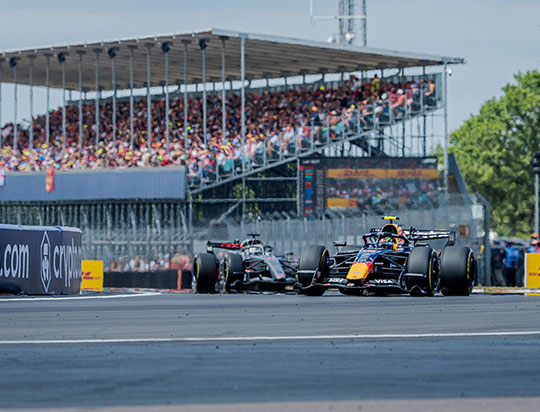
Where Spielberg tests components in short, violent bursts, Silverstone's long, high-speed corners test how much sustained load a car's structure and mechanisms can take without failing.
The 2026 British Grand Prix made that distinction clear. Charles Leclerc took the win for Ferrari, ahead of George Russell and Lewis Hamilton, but the race was defined as much by what went wrong as by who came out on top.
Max Verstappen crashed out at Stowe after a rear wing problem, Nico Hulkenberg retired with a suspected gearbox issue, Alexander Albon was eliminated by an early collision, and Kimi Antonelli, who had led for long spells after taking pole and winning Saturday's Sprint, was reduced to fighting for a single point after a left-front wheel assembly problem forced him into repeated stops.
Four different failure modes, on four different cars, in a single race weekend.
A Circuit Built on Sustained Speed, Not Short Shocks
At 5.9km, Silverstone is one of the longer laps on the calendar, and its identity is built around flowing, high-speed sequences rather than isolated braking zones.
The Maggotts–Becketts–Chapel complex and the run through to Stowe put a car's aerodynamic and motorsport structural components under continuous, high-magnitude load for extended periods, rather than the short, sharp spikes seen at a circuit like the Red Bull Ring.
That distinction matters for design. A structure that only has to survive a brief peak load can be optimised differently to one that has to hold its integrity through several seconds of sustained cornering force at well over 200mph.
Silverstone doesn't forgive a component that's marginal under sustained load, and 2026 bore that out.
When Aerodynamic Devices Fail at Speed
Two of the weekend's defining moments were aerodynamic component failures.
Verstappen's retirement came after his rear wing failed to close correctly, disrupting airflow and destabilising the car before he lost control and crashed at Stowe, one of the fastest corners on the calendar.
Oscar Piastri's McLaren, meanwhile, was pictured running with visible front wing damage during the race. Movable aerodynamic devices, whether DRS-related mechanisms or wing assemblies more broadly, depend on actuation systems and structural elements that have to operate reliably at high speed under significant aerodynamic load, cycle after cycle, without the margin for even minor mechanical failure.
At a circuit where the consequence of an aero failure is a loss of downforce at close to maximum speed, the design and manufacturing tolerances on these components carry unusually high stakes.
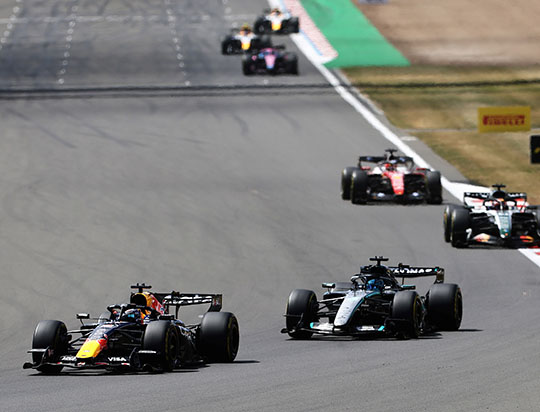
Gearbox and Wheel Assembly Reliability Under Continuous Load
Away from the aerodynamics, two further retirements pointed to the mechanical side of the same problem.
Hulkenberg's race ended with a suspected gearbox issue, while Antonelli's afternoon was compromised by a problem with a left-front wheel assembly that forced him to make repeated unplanned stops, costing him a result that had looked like a likely podium.
Gearbox housings and wheel assembly components at Silverstone are subjected to continuous high-frequency loading through fast corners rather than the occasional heavy impact seen elsewhere on the calendar, and any weakness in casing rigidity, mounting tolerance or fatigue resistance is more likely to be found out over a full high-speed race distance than it would be at a lower-speed circuit.
Contact, Kerbs and the Cost of Structural Compromise
Not every retirement at Silverstone comes down to sustained load.
Albon's race ended following an early collision, a reminder that even at a high-speed circuit, incident damage remains one of the most common causes of retirement, and that crash structures and bodywork still need to protect the rest of the car's systems when contact does happen.
A car that's been optimised purely for outright stiffness at the expense of impact resistance is trading one kind of reliability risk for another, and Silverstone's mix of high average speed with a genuine risk of first-lap contact makes that balance harder to get right than it might first appear.
The Supply Chain Behind a High-Speed Weekend
As with any circuit, none of this reliability is built at the track.
It's built in the months of design, testing and manufacturing that precede a race weekend, and that depends on teams being able to source and process the right high-performance alloys, plastics and composites to the tolerances a circuit like Silverstone demands.
A gearbox casing, a wing mounting bracket or a wheel assembly component that's marginal on fatigue resistance under sustained high-speed load is a design and materials decision made long before the car reaches Northamptonshire, not something that can be fixed trackside.
Teams working to Formula 1's in-season development cycle need suppliers who can turn material round quickly, with full traceability, so that the next iteration of a component is ready before it's needed rather than after a failure has already happened.
Where Smiths High Performance Fits In
This is where Smiths High Performance fits into the picture. As a stockholder and supplier of high-performance alloys and plastics to the global motorsport sector, SHP works with teams to meet exactly this kind of challenge: rapid turnaround, full material traceability, and the technical support to specify the right material for a genuinely demanding application.
A circuit like Silverstone tests whether a car's components can hold their integrity under sustained, repeated load at high speed, and that resilience starts with getting the material right, long before the lights go out.
Get in touch with Smiths High Performance to discuss your team's material and supply requirements.
Smiths HP is a Tier 1 supply chain partner to the global motorsport industry, supplying high-performance alloys and engineering plastics to Formula 1, MotoGP, WEC, NASCAR and WRC.
Contact usat info@smithshp.com or call +44 (0)1767 604 708.