
Ferrium® C61
(Gear Steel)
Offering a superior alternative
Ferrium® 61 is a case-hardened Gear Steel with an ultra-high-strength core.
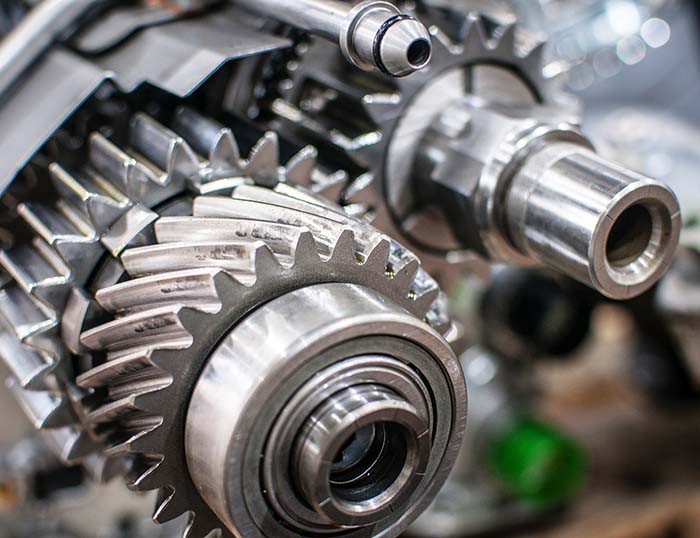
Advances in racing engine designs and increased engine power have caused an increase in the failure of dog rings, gears, camshafts, input shafts, racks and pinions.
Design History:
The design objective for Ferrium® C61 was to develop a high-performance secondary-hardening gear and bearing steel with similar surface properties to conventional gear steels such as AISI 9310 and EN36C. However, with the added benefits of an ultra-high-strength core and excellent fracture toughness. Ferrium® C61 is a member of a new class of martensitic secondary-hardening gear and bearing steels that utilise an efficient M2C precipitate strengthening dispersion. Because of the efficiency of this strengthening dispersion, a superior combination of properties is possible for a given application. Ferrium® C61 was designed to provide carburised surface properties (60-62 HRC) similar to conventional gear steels such as AISI 9310 and EN36C with the additional benefit of an ultra-high-strength core and excellent fracture toughness.
Advantages:
Ferrium® C61 is a superior alternative to conventional gear products such as AISI 9310 and EN36C for new smaller, lighter, high-temperature resistant component designs or to upgrade the material in an existing component where a re-design is not feasible. Ferrium® C61 has surface-wear properties similar to those found in popular commercial alloys but provides an ultra-high-strength, high-toughness, high-temperature-resistant core. Other features include superior axial and STBF fatigue resistance. Ferrium® C61 is particularly advantageous for reducing integrally geared driveshafts' size and weight.
Processing:
Ferrium® C61 is a high-temperature carburising product. Solution heat treatment and carburising treatment are combined. The alloy is quenched directly from the carburising temperature. After quenching to room temperature, Ferrium® C61 is subjected to liquid nitrogen immersion to ensure a complete martensitic transformation. It is typically tempered at 900°F (482°C) and has excellent thermal resistance approaching this temperature. If desired, replacing carburising with nitriding will result in improved surface hardness. Using nitriding and case carburising may result in a brittle surface, resulting in sub-surface spalling initiation and significantly lower fatigue life; users should complete internal trials before considering this combination.
Case Carburising:
Case carburising produces a gradient in the volume fraction of the M2C carbides and increases hardness and surface residual compressive stress. The efficiency of the M2C strengthening response allows this class of steels to achieve very high surface hardness with reduced carbon content. Thus, this class of steel meets very high surface hardness without the formation of detrimental primary carbides. For superior fatigue performance, we recommend final shot peening.

- Ultra-high strength core
- Excellent fracture toughness
- Case hardened
- High surface hardness
- Gears
- Bearings
- Driveshafts
- Camshafts