
Spa-Francorchamps: The One Circuit That Asks a Car to Be Two Different Cars
No circuit on the calendar asks more contradictory questions of a car's set-up than Spa-Francorchamps.
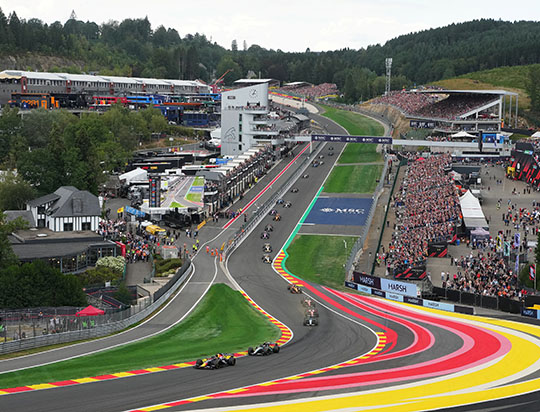
At 7km, it's the longest lap in Formula 1, and it packs in a sustained high-speed compression through Eau Rouge-Raidillon, one of the longest flat-out straights of the season down to Les Combes, a demanding high-speed corner at Pouhon, and a tighter, more technical final sector through the Fagnes Chicane.
The 2026 Belgian Grand Prix illustrated exactly how unforgiving that combination can be. Kimi Antonelli took his sixth win of the season after a dramatic fight with Max Verstappen, who stormed past at Eau Rouge on the opening lap before losing the lead again, while George Russell's race ended on lap one after contact with Lewis Hamilton sent him into the gravel.
Hamilton himself, along with Alpine's Pierre Gasly, had already crashed at the Fagnes Chicane earlier in the weekend, forcing both Ferrari and Alpine to rebuild cars before the race even started.
A Track That Refuses to Settle on One Identity
Most circuits reward a fairly consistent design philosophy. Monaco and Hungary want maximum downforce and mechanical grip, while Monza wants minimum drag and outright top speed.
Spa wants both, in the same lap.
The Kemmel straight that follows Eau Rouge-Raidillon is long enough to reward a low-drag rear wing, closer to a Monza-style setup than anything else on the calendar, but the same car then has to generate enough downforce to carry serious speed through Pouhon and the Eau Rouge-Raidillon complex itself without losing the driver's confidence in the front end.
There is no configuration that fully satisfies both requirements.
Every team's Spa set-up is a compromise between straight-line speed and cornering load, and the balance a team chooses says a lot about how they've weighed the risk of one against the other for their specific car.
Eau Rouge-Raidillon and the Structural Case for Overbuilding
Eau Rouge-Raidillon isn't just fast, it's also a compression event.
The uphill transition subjects the car to significant vertical loading right as the driver is committing to a blind, high-speed left-right-left combination, and that load has to be absorbed by the floor, the plank and the suspension without the car bottoming out or losing aerodynamic platform at the exact moment it can least afford to.
Antonelli and Verstappen's opening-lap battle through that section is only possible because both cars can survive that compression at full commitment, corner after corner, without structural or aerodynamic inconsistency creeping in.
A car that's marginal on ride height control or floor stiffness will either lose performance through Eau Rouge or, in the worst case, damage itself trying to hold the line other cars are managing to run.
When Contact Turns Design Philosophy Into a Race Against Time:
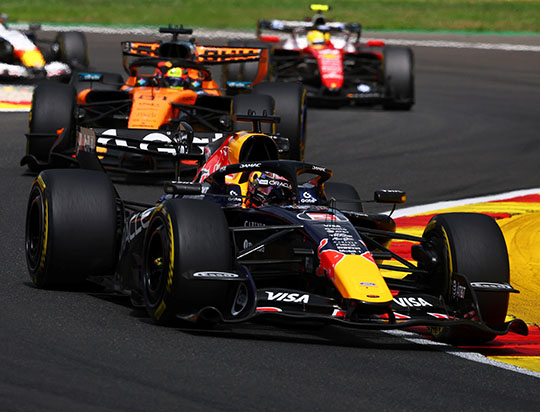
Spa's layout also creates more opportunity for contact than most circuits, both because of its length and because sections like the Fagnes Chicane compress cars together after a long, flat-out run.
Russell's retirement after contact with Hamilton on the opening lap was one example.
The earlier practice incidents involving Hamilton and Gasly at the same chicane were another, and a more instructive one from an engineering perspective: both Ferrari and Alpine had to rebuild parts of their cars before the race, working against the clock across a single race weekend rather than the months of lead time a team would normally have.
That kind of rapid rebuild depends entirely on a team's ability to get replacement components, from bodywork to structural elements, made and fitted to full specification in a matter of hours, not weeks. It's the sharpest possible illustration of why supply chain speed matters as much as design quality in Formula 1, the best-designed component is worthless if a damaged one can't be replaced before the next session.
Designing for a Circuit Unlike Any Other on the Calendar
All of this means Spa specific set-up work rarely translates well to any other race weekend.
The low-drag rear wing that suits the Kemmel straight would be a liability at a circuit like Hungary or Singapore, and the downforce level that keeps a car planted through Eau Rouge and Pouhon would cost lap time on Monza's long straights.
Engineers have to design and validate a genuinely distinct aerodynamic and mechanical package for this one circuit, then set it aside for the rest of the season.
That's a significant use of design and manufacturing resource for a single race weekend, and it only pays off if the components involved, wing elements, floor sections, suspension parts, can be produced to a tight specification and turned around quickly enough to fit into a season that doesn't pause for one-off circuits.
The Supply Chain Behind a One-Off Set-Up
That's true of the bespoke Spa package, and it's even more true when a car needs rebuilding mid-weekend, as Ferrari and Alpine discovered this year.
Both scenarios depend on being able to source and process the right high-performance alloys, plastics and composites at short notice, with full confidence in the traceability and consistency of what's being supplied.
A team that can't get a validated replacement component made and fitted within a race weekend is at a genuine competitive disadvantage, regardless of how good its original design was.
Where Smiths High Performance Fits In
This is where Smiths High Performance fits into the picture. As a stockholder and supplier of high-performance alloys and plastics to the global motorsport sector, SHP works with teams to meet exactly this kind of challenge: rapid turnaround, full material traceability, and the technical support to specify the right material for a genuinely demanding application, whether that's a bespoke Spa-specification component or an emergency rebuild between sessions.
Few circuits test a team's design and supply chain flexibility the way Spa-Francorchamps does, and that resilience starts with getting the material right, long before the car turns a wheel in anger.
Get in touch with Smiths High Performance to discuss your team's material and supply requirements.
Smiths HP is a Tier 1 supply chain partner to the global motorsport industry, supplying high-performance alloys and engineering plastics to Formula 1, MotoGP, WEC, NASCAR and WRC.
Contact us at info@smithshp.com or call +44 (0)1767 604 708.