
Engineering Extremes: Why the Hungaroring Demands a Different Car
Formula 1's return to the Hungaroring this past weekend produced a result few would have predicted at the start of the season, with Lando Norris taking his first win of the year after a mid-race McLaren strategy split and a late retirement for teammate Oscar Piastri.
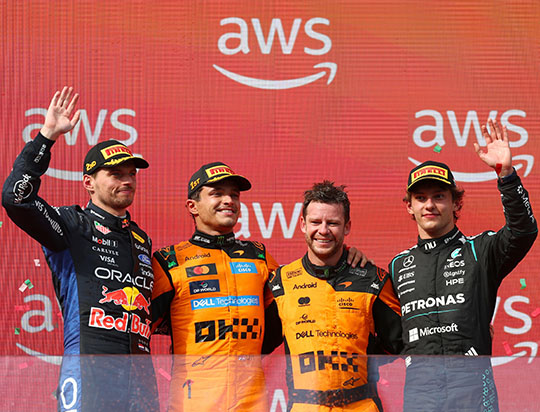
But behind the on-track drama sits a circuit that poses one of the most distinctive engineering puzzles on the calendar, and one that has little to do with outright speed.
Tucked into a natural amphitheatre outside Budapest, the Hungaroring packs 14 corners into just 4.4km, with barely any meaningful straight.
Full-throttle time sits at around 60% of the lap, among the lowest figures of the season, and top speeds rarely exceed 310km/h.
It's often described as "Monaco without the walls", a circuit where precision and mechanical grip matter more than raw pace. For teams, and for the supply chains behind them, that layout creates a very particular set of demands.
The Cooling Problem
Most circuits give a car's power unit and brakes a chance to breathe on long straights, with cool air flooding through radiators and ducts between braking zones.
The Hungaroring doesn't allow for that.
With corner following corner and only a handful of seconds spent at full throttle, airflow through the car is constantly restricted, and that's before accounting for Budapest's summer heat, where track temperatures regularly climb past 45°C.
The result is a circuit that punishes cooling inefficiency more than almost anywhere else on the calendar.
Teams typically arrive with revised bodywork louvres, larger brake ducts and circuit-specific cooling packages, all designed to move more air through a car that's fighting for every degree of thermal headroom.
It's a reminder that the materials inside those cooling and braking systems, from ducting to structural components around the sidepods, need to perform reliably under sustained thermal cycling, not just occasional peak loads.
The Downforce Trade-Off
Because there's so little full-throttle running, teams run some of the highest downforce configurations of the season, closer to Monaco than to a "normal" circuit.
But more downforce means more drag, and more drag means even less airflow reaching the radiators.
Every setup decision at the Hungaroring becomes a trade-off between grip and heat, and getting that balance wrong costs lap time in both directions.
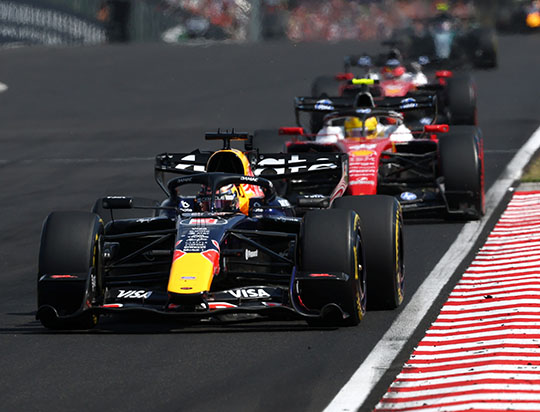
A Tyre Puzzle With no Easy Answer
The Hungaroring's corners generate tyre heat through constant direction changes rather than sustained high-speed loading.
That's a different stress pattern to circuits like Silverstone or Spa, and it shows up in unexpected ways, this year's hard compound has, on several occasions, struggled to reach its working temperature window at all, effectively inverting the usual relationship between tyre hardness and durability.
Teams have had to rethink strategy assumptions built up over years at other venues.
Consistency Over a Single Lap
With overtaking notoriously difficult, turn 1 remains close to the only realistic opportunity all race, track position matters enormously, and that puts a premium on components that perform predictably lap after lap rather than in a single quick burst.
A car that's fast but inconsistent is far more costly here than at a circuit where a driver can simply pass on track.
None of this is solved by one clever part or a single setup tweak.
It's the product of components across the car, bodywork, brakes, suspension, cooling systems, all engineered to hold their performance under a specific and unusual combination of heat, downforce and directional load.
That's the kind of demand our customers are designing for long before a car reaches Mogyoród, and it's exactly the environment our materials are supplied for.
What Makes the Hungaroring Unique on the F1 Schedule, and How Do Engineers Overcome It?
No other circuit on the calendar combines these particular pressures in quite the same way.
The Hungaroring's constant sequence of corners removes the cooling opportunity that a long straight would normally provide, and it does so in some of the highest ambient and track temperatures of the season.
At the same time, the layout demands a maximum-downforce setup more associated with Monaco, which only adds drag and reduces airflow further.
The corners themselves load the tyres through repeated direction changes rather than sustained speed, producing a wear and temperature pattern that doesn't match circuits like Silverstone or Spa.
And because overtaking is so difficult, small inconsistencies in performance are punished over a full race distance rather than being correctable on track.
Engineers and Designers Don't Overcome this with a Single Fix
They respond across the whole car, revised bodywork louvres and larger brake ducts to recover cooling margin, wing and diffuser changes to find downforce as efficiently as possible, and setup work across suspension and differential to protect tyre life without giving up traction out of the slow corners.
Every one of those responses depends on components and materials that hold their properties under sustained thermal cycling and repeated directional load, which is precisely the environment our customers are engineering for at the Hungaroring.
Smiths HP is a Tier 1 supply chain partner to the global motorsport industry, supplying high-performance alloys and engineering plastics to Formula 1, MotoGP, WEC, NASCAR and WRC.
Get in touch with Smiths High Performance to discuss your team's material and supply requirements.
Contact usat info@smithshp.com or call +44 (0)1767 604 708.