
Red Bull Ring, Real Margins: What the Austrian Grand Prix Exposed About Component Reliability
The Red Bull Ring is one of the shortest circuits on the Formula 1 calendar, but its lap time flatters it. In just 4.3 km, the track combines heavy braking zones, sharp elevation change and a sequence of high-kerb corners that punish anything built with insufficient margin.
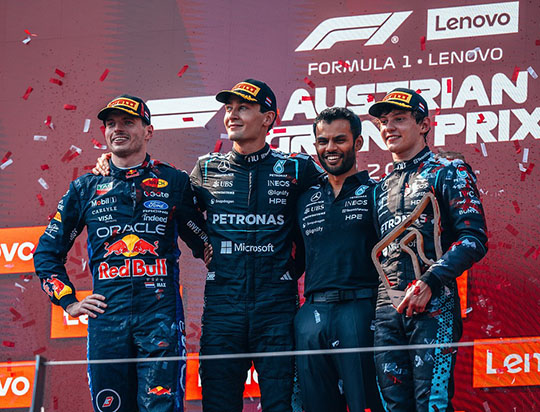
The 2026 Austrian Grand Prix was a reminder of exactly that, a race won on tyre management, but shaped by component failures that had nothing to do with driver error.
Two cars retired with brake issues before the race was a third of the way done. A third retired with a suspected electrical fault, bringing out the Virtual Safety Car.
Together, these incidents highlighted the kind of braking, thermal and structural pressures the Red Bull Ring places on an F1 car.
A Short Lap With a Long List of Demands
Spielberg's layout is deceptive. A 4.3 km lap sounds gentle compared with circuits like Spa or Silverstone, but the Red Bull Ring compresses its challenges rather than spreading them out.
The track rises and falls through more than 60 metres of elevation change across the lap, loading and unloading the car's suspension and structural components in ways that flatter circuits rarely replicate.
Several corners are taken over aggressive kerbs, particularly through the middle sector, which puts repeated high-frequency shock loading through wishbones, uprights and mounting hardware.
None of this is dramatic on its own. Over a full race distance, in temperatures that regularly push into the low thirties, it becomes a cumulative fatigue problem rather than a single point of failure.
Braking Under Sustained Thermal Load
Braking at the Red Bull Ring is unusually severe for the lap length.
Turns 3 and 4 in particular demand heavy, repeated deceleration from high speed, and the short lap means there is little time between braking events for temperatures to fully recover before the next one.
Add a hot race weekend on top and the thermal load on brake discs, calipers and the surrounding mounting structures compounds quickly across a race distance. A component that copes comfortably at a cooler circuit with longer straights and more cooling time can be operating close to its limit here.
This is a materials and design problem as much as a set-up one. The alloys used in brake ducting, calliper mounts and surrounding structural elements need to hold dimensional stability and mechanical strength under sustained, repeated thermal cycling, not just survive a single hard stop under test conditions.
Two retirements from brake issues in one race is a reasonable indication that this margin was tested to its limit this year.
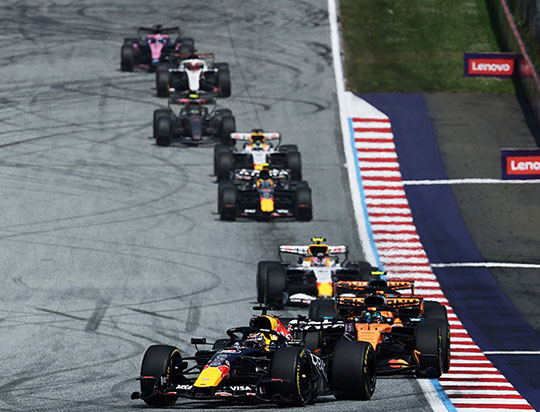
Electronics and the Heat They Can't Escape
The electrical failure that ended a third car's race points to a related but distinct problem.
Modern F1 cars carry an increasing amount of sensitive electronics low in the chassis and close to the power unit, in an environment already saturated with heat from the brakes, the engine and, at a circuit like the Red Bull Ring, the ambient temperature itself.
Unlike a brake disc, which is designed to run hot, onboard electronics have a comparatively narrow operating window before reliability starts to degrade.
Enclosures and mounting materials for this equipment have to manage and dissipate heat without adding unnecessary mass, and do so reliably across a full race distance where there is no opportunity to intervene once the car is out on track.
Getting this wrong doesn't always show up as an immediate failure, it can show up as a fault that appears under exactly the compounded thermal stress a circuit like Spielberg creates.
Tyres, Track Temperature and the Knock-On Effect
The race itself was ultimately decided by tyre management rather than outright pace, with the leading drivers managing degradation across their stints to control the pace of those behind.
That's a driver and strategy story on the surface, but it has a materials dimension too.
Track temperature affects not only tyre degradation but the thermal environment every other component on the car is operating in, brakes, suspension, bodywork and electronics all run hotter on a hot track day, and a car built with tight margins on any one of those systems has less capacity to absorb a hotter-than-expected race.
Reliability at circuits like this is rarely about a single component failing in isolation; it's about how much headroom the whole car has when several systems are under thermal stress simultaneously.
The Supply Chain Behind the Margin
None of this is solved by design alone.
Building in the margin a circuit like the Red Bull Ring demands depends on being able to source and process the right high-performance alloys, plastics and composites quickly enough to iterate ahead of the next race weekend, and with full confidence in the traceability and consistency of what's being supplied.
Teams operating on Formula 1's compressed in-season development cycle don't have room for uncertainty in their supply chain. A delayed batch, an unverified material property, or a supplier that can't confirm full traceability back to source can be the difference between a component that survives Spielberg's demands and one that doesn't.
Procurement decisions made months before a race weekend are, in a very direct sense, part of what determines whether a car finishes it.
Where Smiths High Performance Fits In
This is where Smiths High Performance fits into the picture.
As a stockholder and supplier of high-performance alloys and plastics to the global motorsport sector, SHP works with teams to meet exactly this kind of challenge: rapid turnaround, full material traceability, and the technical support to specify the right material for a genuinely demanding application.
Circuits like the Red Bull Ring don't leave much room for error in component design, and that margin starts with getting the material right, long before the car reaches the track.
Get in touch with Smiths High Performance to discuss your team's material and supply requirements.
Smiths HP is a Tier 1 supply chain partner to the global motorsport industry, supplying high-performance alloys and engineering plastics to Formula 1, MotoGP, WEC, NASCAR and WRC.
Contact us at info@smithshp.com or call +44 (0)1767 604 708.