
The Benchmark Circuit: Why the Barcelona-Catalunya Grand Prix Remains Formula One's Most Complete Engineering Examination
There are circuits on the Formula One calendar that test one thing exceptionally well. Monza tests straight-line speed. Monaco tests precision and mechanical grip. Spa tests aerodynamic balance and weather adaptability.
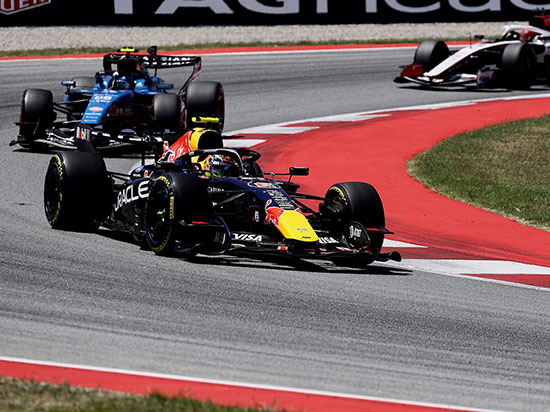
The Circuit de Barcelona-Catalunya, by contrast, tests everything simultaneously — and has done so for every team on the grid since 1991.
It is not coincidence that Formula One teams spent decades using this circuit as their primary pre-season testing venue. Barcelona exposes a car's true performance across the full spectrum of engineering demands: high-speed stability, low-speed mechanical grip, tyre management under sustained lateral load, aerodynamic efficiency on long straights, braking stability under thermal stress, and, in 2026, energy deployment under the new active aerodynamic regulations.
If a car is fast here, it is genuinely fast.
Round seven of the 2026 Formula One World Championship brought the first running of the event under its new Barcelona-Catalunya Grand Prix title — the Spanish Grand Prix designation having been reassigned to a debut race at Madrid's new Madring circuit later in the season. Kimi Antonelli arrived in Montmeló having won five of the season's first six races, leading the Drivers' Championship by 66 points from Lewis Hamilton and 68 from Mercedes teammate George Russell. He did not finish. Hamilton did — and with it claimed his first Grand Prix victory for Ferrari, his first win in nearly two years, and his 106th in total, making him the oldest Formula One race winner since Jack Brabham in 1970.
The podium of Hamilton, Russell and Lando Norris was the first all-British Formula One podium since 1968. Mercedes' five-race winning streak was ended. Ferrari had broken through. The championship fight, which had threatened to become a procession, reopened. That outcome was the product of strategy, pace, fortune and a Virtual Safety Car triggered by Fernando Alonso's retirement. But beneath the narrative, it was also the product of engineering decisions — made in the factory, refined through practice sessions and executed with precision across 66 laps on one of the most demanding surfaces in the sport. Barcelona, as ever, provided the examination. The results reflected who had answered it most completely.
The Circuit and Its Reputation
The Circuit de Barcelona-Catalunya is 4.7 kilometres of asphalt laid down in 1991 on the outskirts of Montmeló, 20 kilometres north of Barcelona city. It is one of the oldest surfaces still in regular Formula One use — and that age is one of the defining technical facts of the weekend.
The abrasive tarmac has degraded over decades of racing, testing and general circuit use, creating a surface that generates exceptionally high rates of tyre wear and places sustained thermal stress on the compounds that must work across it. The layout packs 14 corners into those 4.7 kilometres, covering a range of speeds and loading profiles that few circuits can match. The opening sector leads into the long, high-G right-hander at Turn 3, one of the most demanding single corners in the championship. The mid-section climbs through the sweeping uphill Turn 9 before descending into the La Caixa hairpin at Turn 10, the circuit's heaviest braking point.
The final sector, revised in 2023 to remove the slow chicane that previously interrupted the run to the start/finish straight, now flows more freely onto a pit straight that allows cars to reach around 320 km/h before braking into Turn 1. That revision — closing out the lap with more speed rather than less — has direct implications for tyre loading, aerodynamic configuration management and the approach to overtaking.
The circuit's asymmetry is a structural engineering fact rather than a quirk of design. Nine of its 14 corners are right-handers, five left-handers. Every sustained lateral load event falls disproportionately on the left side of the car. The front-left tyre in particular is subjected to cumulative thermal and mechanical stress across the lap that the front-right is not, because the major load events all ask more of the outside front tyre. Managing the degradation of one corner of the car while maintaining balance across the other three is one of the baseline tyre challenges of a Barcelona race weekend. It is also one of the reasons why the circuit has been so revealing of car weaknesses: an imbalanced car simply cannot hide it when one specific tyre is under attack at every significant corner of the lap. For the 2026 race, the calendar shift added an additional variable.
The event moved approximately two weeks later in the season compared with its traditional June slot, meaning track temperatures during the race weekend consistently surpassed 50 degrees Celsius — higher than teams had typically experienced at this venue in recent years. Hamilton's three-stop strategy, dismissed by some as overly aggressive before the race, became the correct call under those conditions. The pace advantage of fresh rubber on a track surface that degrades compounds rapidly, and the gap that opened against two-stopping rivals managing temperatures rather than chasing lap time, was the underlying engineering logic that delivered Ferrari's first 2026 victory.
The Aerodynamic Balance Problem
Barcelona's defining aerodynamic challenge is one that engineers have worked against for three decades: the circuit requires a car to be simultaneously efficient on long straights and stable through high-speed sustained corners.
Those two demands pull in opposite directions. More wing angle generates more downforce, which is what high-speed corners like Turn 3 demand for stability and tyre load management. But more wing angle also means more drag, which costs straight-line speed on the main straight and the run from the Swimming Pool complex to the final corner. Less wing angle reduces drag and recovers straight-line performance, but leaves the car less planted through the fast corners and accelerates the process by which tyre degradation compounds at Turn 3 — because a less aerodynamically loaded car generates more tyre slip to find its cornering force. In 2026, the active aerodynamic system introduced under the new technical regulations — Straight Mode, which transitions the front and rear wings between a high-downforce Corner Mode configuration and a low-drag Straight Mode — was operating in full for the first time at a conventional high-speed circuit after being disabled entirely at Monaco.
Barcelona's layout received four designated Straight Mode zones: the main pit straight, the approach to Turn 1, and two entirely new activation points introduced for 2026 — one on the exit of Turn 3 through to Turn 4, and one descending from Turn 5 into Turn 6. Those two new zones are specific to the 2026 regulations and represent a qualitative change in how the circuit operates.
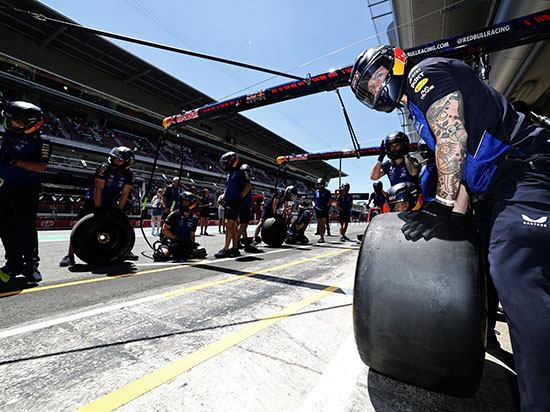
Tyres, Temperatures & The Strategy That Won The Race
Tyre degradation at Barcelona is thermal in nature rather than mechanical. The compounds wear, certainly, but the primary degradation mode is temperature-driven: the front-left, subjected to the highest sustained lateral loading on a circuit where the right-hand bias never relents, builds heat faster than it can dissipate it across a stint.
That heat accumulation is not linear — it is progressive, meaning that the compound remains in its working window for the early laps of a stint before thermal build-up begins to attack the structure of the rubber itself.
The point at which degradation inflects — where the tyre transitions from working to suffering — is the key variable around which Barcelona strategy is constructed. At 50-degree track temperatures on a softer-than-usual compound allocation, that inflection point arrived earlier in 2026 than teams had modelled. The medium-running Mercedes cars found themselves managing degradation more actively than planned from around lap 18 of a targeted 25-lap stint. Hamilton, committed to Ferrari's three-stop plan from the outset, was running on fresher rubber at each comparison point, posting laps 1.3 to 1.5 seconds quicker than the leading Mercedes in the middle phase of the race. The pace differential was visible, but the gap to the front was large enough that a free stop was still needed to complete the conversion. The Virtual Safety Car, triggered when Alonso's Aston Martin stopped at Turn 9 on lap 40, provided exactly that — closing the pit lane time loss to nearly zero on a stop that promoted Hamilton to the lead at no net cost.
For Pirelli, the compound allocation decision was itself a considered engineering judgement. Bringing the C2 as the hardest compound — typically not used at Barcelona, where the C3 is the usual floor — was intended to encourage more pit stops and inject strategic variance into a circuit that has historically tended towards processional racing once track position is established.
That goal was met. The race produced genuine three-stop feasibility, elevated tyre stress conversations throughout the weekend and a strategy outcome that rewarded the team willing to push against the conventional approach. The engineering risk that Ferrari accepted — starting Hamilton on the soft compound in a race where most rivals chose medium, trusting that three stops would be viable — was the correct call because the tyre data from Friday had indicated the medium's degradation rate would be higher than models predicted under those track temperatures.
What Barcelona Reveals - And Why It Matters
For over three decades, engineers have used the Circuit de Barcelona-Catalunya as their most reliable reference point precisely because it asks questions that cannot be avoided.
A car with a floor management issue will be exposed by Turn 3. A car with a brake bias problem will show it at Turn 10. A car with a tyre preparation weakness will lose qualifying laps at the temperature-sensitive final sector. A car with an active aerodynamic calibration error will bleed time in the Straight Mode zones every lap of the race.
There is no corner of the circuit where a weakness can be hidden by circuit characteristics, as there might be at Monaco's near-unique layout or at Baku's wall-bounded straights. That completeness is why Barcelona's data has underpinned so much of Formula One's development work over the years — and why the 2026 event, the first under the new active aerodynamic regulations at a conventional high-speed circuit after Monaco's unique restrictions, carried particular significance for every team's engineering programme.
The data gathered across the three practice sessions and 66 race laps will inform every subsequent development decision of the season. Which aero configurations are working in Straight Mode transitions, where energy deployment is being recovered or lost, how degradation rates scale with compound choice at elevated temperatures — all of it feeds back into development programmes that will be running until the final round.
Antonelli's retirement with an electrical failure — arriving just moments after he had finally cleared Russell for second place on lap 61, with three laps remaining — was a reminder that component reliability under sustained electrical and thermal stress is not a separate problem from the aerodynamic and strategic challenges that define Barcelona race weekend preparation. It is the same problem expressed differently. A power unit asked to harvest and deploy energy continuously across a 66-lap race on a circuit where four Straight Mode zones demand active aerodynamic transitions every lap is a power unit under a loading profile that did not exist at this circuit in any previous season. Understanding and managing that loading — both in terms of system architecture and the material specification of the components through which that energy flows — is as much a part of Barcelona engineering preparation as the wing settings and the tyre strategy.
Where Smiths High Performance Fits In
The Circuit de Barcelona-Catalunya's status as Formula One's most complete examination is, at its foundation, an argument for the importance of material quality across every component of a racing car.
A circuit that tests everything tests the integrity of the materials that every component is made from. Brake disc assemblies managing repeated high-energy deceleration from 300 km/h at Turn 10. Suspension uprights carrying asymmetric lateral loads through 66 laps of right-hand biased cornering. Aerodynamic actuator mechanisms cycling between Corner Mode and Straight Mode through four designated zones on every single lap. Chassis structures absorbing the combination of high-speed aerodynamic loading and the surface imperfections of one of the oldest circuits in the championship.
In each case, the performance of the component under the specific loading that Barcelona creates is determined not only by the engineering applied to it, but by the specification and quality of the raw material from which it was built. Smiths High Performance is the specialist supply chain partner that ensures those materials are right. As a Tier 1 supplier to all of the major teams on the grid, the company provides advanced engineering alloys and high-performance plastics with full traceability — from aluminium and aluminium-lithium alloys, titanium and nickel superalloys to high-performance steels, magnesium, beryllium copper and engineering plastics — supporting teams across every material selection decision that a circuit like Barcelona demands.
A car that performs well at Barcelona performs well almost everywhere. The engineering decisions that underpin that performance begin in the material supply chain. Smiths High Performance is where many of those decisions start.
Smiths HP is a Tier 1 supply chain partner to the global motorsport industry, supplying high-performance alloys and engineering plastics to Formula 1, MotoGP, WEC, NASCAR and WRC.
Contact usat info@smithshp.com or call +44 (0)1767 604 708.