
The Most Demanding Kilometres in Motorsport: Why Monaco Confronts F1 Engineers With Problems Found Nowhere Else on the Calendar
Round six of the 2026 Formula One World Championship took Formula One to the Circuit de Monaco — and to a set of engineering demands that are, in almost every meaningful sense, unlike anything else the season produces.
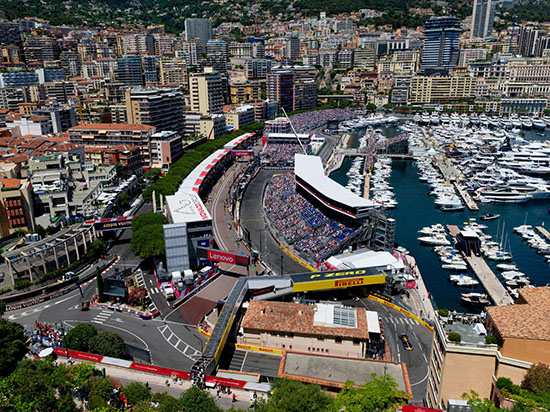
The Principality's street circuit is the shortest, narrowest and slowest track on the calendar, yet it consistently produces the most technically intensive weekend of the year. Not because the physics are complex — they are, in places, comparatively simple — but because the constraints are absolute. Concrete barriers a matter of centimetres from the racing line, no room to recover from a mistake and no opportunity to overtake once a position is lost make every engineering decision, from wing specification to suspension stiffness, feel as though it carries permanent consequence.
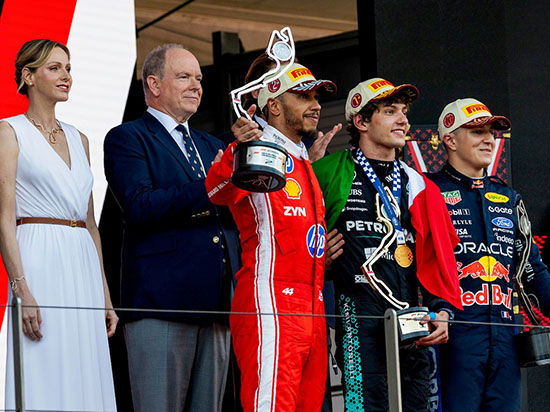
Kimi Antonelli arrived in Monaco having already won four of the season's first five races, leading the Drivers' Championship by 43 points from Mercedes teammate George Russell. He left with a fifth victory, his fastest lap of the race, a Grand Slam and a 66-point lead — having navigated a Safety Car, a red flag, a wave of pit lane penalties and seven retirements, including Verstappen on the opening lap and Leclerc late in the race, with the same composed precision that had characterised his entire 2026 campaign.
It was a result that underlined not just his extraordinary ability, but the technical soundness of a car that was able to manage Monaco's most unforgiving demands across 78 laps without fault. For the engineering teams behind every car on the grid, however, the Monaco Grand Prix begins weeks before the first practice session — in the factory, in the simulator, and at the drawing board.
Monaco and Aerodynamic Problem
The starting point for every engineering decision at Monaco is downforce — specifically, how to generate as much of it as possible in a regulatory environment that normally requires teams to balance aerodynamic load against drag. At most Formula One circuits, that balance is the central tension of car design. More downforce means more grip in corners, but also more aerodynamic drag on the straights, which costs straight-line speed. Teams build their wings around a carefully calculated compromise between the two demands, and the specific characteristics of each circuit — its corner speeds, straight lengths and braking profiles — determine where that compromise should sit. Monaco dissolves that tension almost entirely.
The circuit's longest straight — from Tabac through the Swimming Pool section to Rascasse — barely exceeds 300 metres. There is no high-speed blast down which drag translates meaningfully into lap time loss. The isochronal ratio at Monaco — the relationship between adding downforce and losing time to additional drag — is uniquely favourable, meaning that adding grip through more downforce costs far less lap time here than at any other venue. The engineering response is unanimous: maximum downforce, regardless of what it adds in drag.
In 2026, teams went further still, because the season's new active aerodynamic architecture — the Straight Mode system that transitions wings between high-downforce and low-drag configurations on designated straights — was disabled entirely by the FIA for Monaco on safety grounds. With no straights long enough to make the system meaningful, and concerns about the distraction of aerodynamic configuration changes on the narrow, barrier-lined circuit, the wings were locked in their fixed positions throughout the weekend.
That decision opened a specific design opportunity: the actuator mechanisms that control the active aero system were stripped from the cars, saving weight and freeing the packaging space they occupied. Teams moved quickly to fill that space with additional downforce-generating aerodynamic devices — additional winglets fitted to the rear wing upper flaps — in configurations that would only ever see the light of day at Monaco. Mercedes, Red Bull and McLaren all brought particularly complex multi-element solutions, while Audi, Ferrari, Racing Bulls and Cadillac adopted simpler interpretations. The objective in every case was the same: recover downforce through mechanical means now that the active system was unavailable. The result is a car built specifically for this circuit and no other — an extreme interpretation of the regulations that maximises grip at the cost of straight-line efficiency that simply does not matter at Monte Carlo.
The Suspension Paradox
If the aerodynamic approach at Monaco is relatively straightforward — add downforce — the suspension problem is anything but. It presents engineers with a genuine paradox that cannot be fully resolved, only managed.
The Circuit de Monaco is not a smooth surface. Years of street use and repeated patching have left it bumpy and irregular, and the 2026 season saw resurfacing work completed on the start/finish straight and the Turn 7-8 complex. On a conventional circuit, the response to a rough surface is to soften the suspension — allowing the wheels to follow the road's irregularities rather than transmitting every bump into the chassis. A softer suspension is more compliant, generates better mechanical grip on imperfect surfaces and makes the car more predictable through the corners.
At Monaco, that instinct is counterproductive. Ground-effect aerodynamics — which generate downforce by accelerating airflow under the floor of the car — require a consistent, controlled relationship between the car's floor and the road surface. If the suspension is too soft, ride height variation becomes excessive, the aerodynamic seal under the floor breaks down and downforce drops unpredictably. Running stiff suspension preserves aerodynamic consistency, but transfers every surface imperfection directly into the car's handling, creating sudden loading changes that are particularly dangerous when the barriers are centimetres away. Monaco has both low-speed technical content — the hairpins, the chicanes, the tight direction changes — and genuinely fast sections, including the ascent through Massenet to Casino Square, the flat-out blast through Tabac and the entire Swimming Pool sequence, all of which generate significant aerodynamic load.
Getting the suspension calibration wrong at either end of that speed range costs lap time, and at Monaco, lap time is decided in qualifying — where track position on Sunday morning is almost entirely determined by Saturday's grid. The suspension paradox extends to a specific mechanical challenge at the Loews Hairpin — the slowest corner on the Formula One calendar, navigated at speeds below 50 km/h with virtually full steering lock. No standard F1 front suspension geometry allows sufficient steering angle to navigate this corner cleanly. Every team modifies its front suspension specifically for Monaco: shorter steering arms, revised rack stops or adjusted trackrods to permit the extreme lock required. These are bespoke components, manufactured for this circuit alone, designed to a tight specification and never used at any other round of the season.
Heat Without Speed: The Brake and Power Unit Challenge
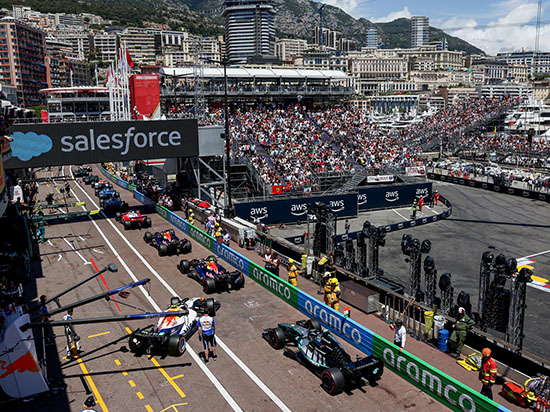
Monaco is not a circuit that taxes the brakes in the way that Montreal does — there are no long, high-speed straights from which cars must decelerate to hairpin speed in one enormous energy-removal event. But that comparative simplicity conceals a specific thermal problem that engineers must manage carefully across race distance. The braking zones at Monaco are short, low-speed and frequent. Between each one, the circuit offers minimal opportunity for cooling airflow to dissipate the heat that has accumulated. The result is a circuit where brake temperature management is demanding precisely because the continuous cycle of braking events leaves virtually no time between them.
Opening the brake ducts to increase cooling — as teams do to manage extreme temperatures — comes at a direct aerodynamic cost: larger duct openings disturb the airflow around the front wheels and reduce downforce. At Monaco, where every fraction of downforce has been painstakingly generated, sacrificing any of it to manage brake temperatures is a significant compromise.
The decision about how much cooling to allow therefore becomes a genuine strategic trade-off: optimise for qualifying pace with smaller, more aerodynamically efficient duct openings and manage brake temperatures carefully through the race, or sacrifice some qualifying downforce for the security of better cooling.
At a circuit where grid position is almost deterministic of race result, that choice carries unusual weight. The 2026 power unit introduced a further Monaco-specific complication: turbo lag. The new regulatory architecture relies heavily on a larger turbocharger working in partnership with the electrical Motor Generator Unit-Heat.
At low speeds — and Monaco's hairpins and chicanes spend significant time below 80 km/h — the turbocharger cannot maintain the boost pressure required for optimal torque delivery on corner exit. The result is a brief but measurable lag between the driver applying throttle and the engine delivering full power. At Monaco, where traction on corner exit is one of the primary determinants of lap time, that lag is not a minor inconvenience. Teams responded by using the MGU-K's electrical energy deployment to fill in the torque gap while the turbo rebuilt pressure — in effect, substituting battery energy for combustion energy at the precise moment when the combustion engine could not deliver. Monaco's abundance of braking events means battery regeneration is not a constraint here in the way it is at power circuits like Canada or Monza, so the strategy is viable across the lap.
However, it requires precise calibration of the deployment maps to ensure the electrical fill-in is seamless and does not itself create instability on a circuit that punishes any unexpected power delivery.
Tyres On An Unforgiving Surface
Pirelli brought the three softest compounds in their 2026 range to Monaco — C3, C4 and C5 — a selection made necessary by a circuit whose smooth but low-grip asphalt and low-energy corner profile struggle to generate the tyre temperatures that harder compounds require.
The challenge at Monaco is not degradation in the conventional sense. The circuit's abrasion level is low, and rear tyre wear at race pace is manageable. The problem is thermal management in the opposite direction to most venues: getting sufficient heat into the tyre during the outlap and the early phases of a qualifying run to ensure the compound is in its working window when it matters.
The lap is short, the corners that generate lateral energy are brief, and the low-speed sections bleed tyre temperature rather than building it. In the race, the low-wear characteristics of the circuit and the near-impossibility of overtaking combine to make strategy unusually predictable. A single pit stop, executed at a moment determined primarily by the threat of a Safety Car rather than tyre degradation, is the standard approach. The probability of a Safety Car at Monaco — historically very high, and confirmed emphatically by 2026's race weekend, which produced both a Safety Car and a red flag — means that teams plan their strategic responses to intervention well in advance, and the timing of the stop relative to a Safety Car deployment can determine race result far more powerfully than pace alone.
The Consequence of Getting it Wrong
The 2026 Monaco Grand Prix demonstrated, with characteristic clarity, what happens when the margins are not respected. Sergio Pérez's brakes overheated and caught fire during Free Practice 2, ending his session early. Max Verstappen's power unit failed on the formation lap, relegating him from a potential podium contender to a lap-one retirement. Charles Leclerc, Monaco resident and two-time local pole-sitter, crashed at Antony Noghes in the closing stages on cold tyres after the restart, joining Lance Stroll who had struck the same barrier earlier.
George Russell's weekend unravelled through a sequence of pit lane speed infringements and an incorrectly served penalty, turning a potential podium into a finish outside the points.
Seven drivers did not complete the race. Every one of those outcomes had an engineering or operational dimension — a thermal management failure, a component fault, a strategic misjudgement or a handling characteristic that left a driver without the confidence the circuit demands. Through it all, Antonelli's Mercedes held together and held its line. Five wins in six races, fastest lap, pole position and Grand Slam. The engineering platform beneath him did not give him an excuse to get anything wrong. Monaco rarely does.
Where Smiths High Performance Fits in
The Monaco Grand Prix produces a level of bespoke engineering activity that is genuinely unusual even by Formula One standards.
Suspension components designed and manufactured exclusively for this event, aerodynamic devices that exist nowhere else in the season, brake duct configurations and power unit deployment maps calibrated specifically for 3.4 kilometres of street circuit — all of it produced at pace, to the highest possible material specification, and trusted to perform without fault across an 78-lap race in which a single component failure is, in almost every case, unrecoverable.
As a Tier 1 supply chain partner to all of the major Formula One teams, Smiths High Performance provides the advanced engineering materials from which those components are built. The company's portfolio — spanning aluminium and aluminium-lithium alloys, titanium, nickel superalloys, magnesium, high-performance steels, beryllium copper, engineering plastics and more — supports the full spectrum of engineering decisions that a race like Monaco demands.
Whether the application is a bespoke Monaco-specification steering component, a brake caliper assembly, a suspension upright, or a chassis structural element asked to withstand the impact loads that Monte Carlo's barriers occasionally deliver, the quality, consistency and full traceability of the raw material is not a secondary consideration. It is the foundation on which every other engineering decision rests.
At Smiths High Performance, that foundation has been built over two decades of dedicated service to motorsport's most demanding engineering environments. Monaco, with its absolute intolerance for compromise, is perhaps the clearest illustration of why it matters. Smiths High Performance supplies advanced engineering materials to Formula 1 teams and motorsport supply chain partners worldwide. From high-performance aluminium and titanium alloys to nickel superalloys and carbon fibre, our materials are specified for the most demanding operating conditions in motorsport.
Explore our materials range or contact our technical team to discuss your requirements.