
The Wall of Champions and the Weight of Every Decision: How the Circuit Gilles Villeneuve Pushes F1 Engineering to Its Limits
Round five of the 2026 Formula One World Championship brought the paddock to Montreal — and to one of the most technically demanding venues on the calendar.
The Circuit Gilles Villeneuve sits on the man-made Île Notre-Dame in the St Lawrence River, a semi-permanent layout of flat tarmac, long straights, tight chicanes and one of the most unforgiving concrete barriers in motorsport. As the fifth round of the season and the first Canadian Grand Prix to feature the sprint format, it arrived with championship momentum firmly in Mercedes' favour: Kimi Antonelli leading with 100 points, teammate George Russell 20 behind, and Ferrari's Charles Leclerc a further 21 adrift heading into race week.
By Sunday evening, the standings had shifted dramatically — and for reasons that illustrated precisely why Canada is unlike any other race on the Formula One calendar.
What Makes Montreal Different
Most Formula One circuits punish either aerodynamic compromise or mechanical weakness, but rarely both in the same lap. Montreal does both, relentlessly, across 70 laps. The Circuit Gilles Villeneuve measures just 4.4 kilometres, but within that distance it presents engineers with three long full-throttle straights, four major braking zones, the tightest hairpin on the calendar and the notorious Wall of Champions at the final chicane. The circuit's topography is virtually flat — a total elevation change of barely five metres across the entire lap. There is no gradient to assist braking, no camber to support high-speed cornering loads, no geography to exploit. Every force the car generates — whether accelerating, braking or changing direction — is the product of engineering decisions made in the factory months earlier.
It is also a circuit that rewards package balance over outright aerodynamic performance in a way that few venues on the calendar can claim. A team can arrive in Montreal with the most advanced aerodynamic package in the field and still lose to one that has solved the brake cooling and tyre temperature problems the circuit creates. In that sense, Canada is the great equaliser — and one of the most honest indicators of true engineering depth.
The Downforce Dilemma
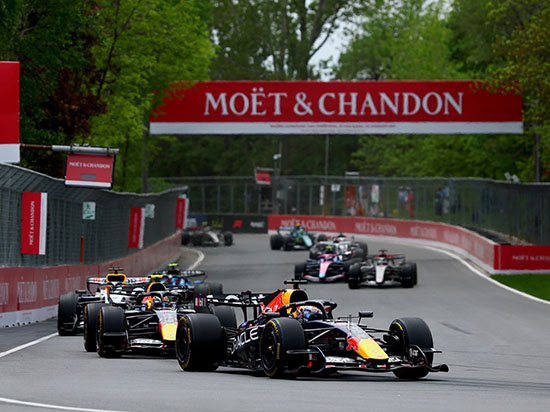
Teams arrive at the Circuit Gilles Villeneuve knowing they must run lower downforce levels than almost anywhere else on the calendar.
The three main straights — including the 1,173-metre Casino Straight where cars reach speeds in excess of 330 km/h — demand low-drag aerodynamic configurations to remain competitive on lap time.
Reducing wing angle reduces drag, it also reduces downforce.
That trade-off creates a cascade of engineering decisions that extends far beyond the aerodynamic package itself. Lower downforce means less vertical load on the tyres in the slow corners, making traction harder to generate on the exit of tight chicanes and the hairpin. It means less aerodynamic braking assistance on the approach to the heavy braking zones — placing the full deceleration burden on the mechanical braking system. And it means less rear stability through the final chicane, the sequence of turns that ends at the Wall of Champions. For the designers and engineers responsible for a car's wing settings and suspension geometry, Montreal therefore demands a setup that accepts a fundamental compromise at almost every point on the lap.
Go too conservative on drag reduction and straight-line speed bleeds away on the Casino Straight. Go too aggressive and the car becomes a liability through the braking zones and at the final chicane, where the wall is as close to the racing line as any barrier on the calendar. The margin between optimal and dangerous at the Wall of Champions is measured in centimetres. In 2026, that balance was further complicated by the new regulatory framework. Four Straight Mode deployment zones on the Circuit Gilles Villeneuve — on the start/finish straight, between Turns 7 and 8, between Turns 9 and 10, and between Turns 11 and 13 — mean that active aerodynamic configuration switching is now a continuous feature of the lap, not a brief DRS activation. Engineers must calibrate the aerodynamic transitions so that the car moves efficiently between high-downforce corners and low-drag straights without destabilising the platform at the moment of transition.
The Braking Problem
If there is a single engineering discipline that defines the Canadian Grand Prix, it is braking. Canada consistently produces the highest brake energy demands of any round on the calendar. The combination of low-drag aerodynamic configuration and repeated heavy braking from high speed — at the hairpin, through the chicanes and into the Senna 'S' complex — places sustained thermal and mechanical stress on brake components that is without parallel at most other venues.
What makes this loading particularly severe is the absence of recovery time between events. At circuits where heavy braking zones are separated by medium and high-speed corners, brakes have opportunity to shed heat through airflow. At Montreal, the straights that precede each braking zone are themselves a source of additional speed — meaning that by the time the driver reaches the braking point, the car is travelling faster than at almost any equivalent point on the calendar. Then, immediately after the braking zone, a tight chicane or hairpin limits the driver's ability to use gradual, progressive braking to manage temperatures.
The result is a cycle of extreme thermal input followed by minimal cooling, repeated at every braking point, across 70 race laps. Brake disc temperatures at Montreal consistently reach levels that make the carbon discs glow visibly through the wheel rims under braking. The brake duct sizing decision — how much cooling airflow to allow through to the disc and caliper assembly — becomes one of the most consequential design choices of the weekend. Open the ducts too far and drag increases meaningfully on the straights, costing lap time. Close them too far and thermal management becomes critical: brake fade on lap 60 at the Wall of Champions is not an acceptable outcome. The chicanes also introduce a specific suspension challenge that compounds the braking problem.
The kerbing through Turns 3 and 4 and the aggressive direction changes through the chicane sequences demand a suspension setup that is compliant enough to absorb the kerb impact without unsettling the car at entry, yet stiff enough to prevent excessive ride height variation that would compromise aerodynamic balance. Getting this calibration wrong means the car arrives at the braking zone in an unpredictable dynamic state — exactly the condition that has sent championship-leading cars into the Wall of Champions.
Energy Management Under The 2026 Regulations
The 2026 Formula One regulations introduced a new power unit architecture with a significantly higher proportion of electrical energy contribution alongside the internal combustion component.
At Montreal, that architecture creates an asymmetric energy management problem that is unique to this circuit's layout. The long straights of the Circuit Gilles Villeneuve require sustained electrical deployment to maintain maximum straight-line speed in Straight Mode. But the same straights offer limited opportunity to harvest energy, because the car is not braking heavily enough to generate meaningful kinetic energy recovery. The tight chicanes and hairpin that follow each straight represent the primary regeneration events on the lap — but their length limits the total energy that can be harvested before the next deployment demand arrives. The result is an asymmetric energy map where the circuit demands more from the electrical system than it gives back on a lap-by-lap basis.
Managing this imbalance across 70 race laps requires engineering precision at the power unit calibration level and real-time monitoring from the pit wall. A driver who depletes their battery reserve early in a stint loses the straight-line speed advantage that Montreal's layout demands, and is immediately vulnerable to being passed on the Casino Straight by a rival with a better-managed energy state. In 2026, the FIA also reduced the qualifying energy harvest limit from 8MJ to 6MJ per lap, meaning that teams had even less electrical buffer available during the single-lap qualifying runs and sprint events.
A Race That Tested Every Assumption
The 2026 Canadian Grand Prix resolved itself through attrition as much as pace. The earlier May race date brought cooler, damper conditions that tested every thermal engineering assumption teams had built into their race weekend preparation.
Tyre preparation was genuinely difficult throughout, the unpredictable weather created strategic uncertainty from the first lap, and the new power unit's energy management demands meant that no team could afford a single miscalculation in deployment strategy. George Russell, having taken pole and converted it into victory in Saturday's Sprint, led the Grand Prix from the front in conditions that initially favoured the Mercedes' electrical architecture.
But an electrical failure — a battery issue that caused his first retirement since the 2024 British Grand Prix — handed the lead to his teammate Kimi Antonelli, who managed the remaining distance to take his fourth consecutive race victory.
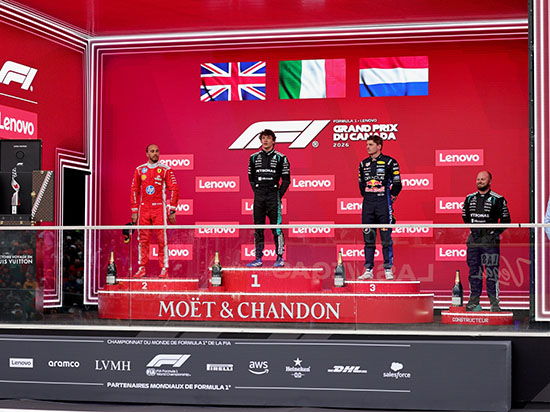
Lewis Hamilton brought Ferrari home in second, with Max Verstappen completing the podium for Red Bull.
The race's high attrition rate — 18 retirements in total, many of them mechanical — underlined the relentless demands that Montreal places on every system of the car. At a circuit where braking loads are exceptional, temperatures unpredictable and the structural consequences of a misjudgement are immediate and concrete, the quality and specification of engineering materials is not a marginal concern. It is a race-defining one.
Where Smiths High Performance Fits in
For every team on the Formula One grid, the Canadian Grand Prix is a reminder that lap time begins in the workshop, not on the circuit. The performance of brake components, suspension elements, power unit architecture and structural chassis members under the specific conditions that Montreal creates is determined by decisions made during the design and manufacturing phase — and those decisions rest on the specification and quality of the raw engineering materials from which the components are built.
Smiths High Performance is the specialist supply chain partner that ensures those materials meet the demands that Formula One imposes. As a Tier 1 supplier to all of the major teams on the grid, the company provides advanced engineering alloys and high-performance plastics with full traceability, supporting teams from initial material selection through to in-season rapid response delivery. At a circuit like Montreal — where brake systems operate at temperatures that would compromise lesser materials, where suspension components must manage conflicting stiffness demands over 70 laps and where a power unit failure can decide the world championship — there is no room for compromise in the material supply chain.
The breadth of Smiths High Performance's portfolio — spanning aluminium and aluminium-lithium alloys , titanium, nickel superalloys, magnesium, high-performance steels, beryllium copper, engineering plastics and more — means that the company supports the engineering decisions that define how a car performs at the most demanding venues on the calendar. When those decisions matter most, the materials have to be right.
Smiths High Performance supplies advanced engineering materials to Formula 1 teams and motorsport supply chain partners worldwide. From high-performance aluminium and titanium alloys to nickel superalloys and carbon fibre, our materials are specified for the most demanding operating conditions in motorsport. Explore our materials range or contact our technical team to discuss your requirements.