
Saudi Arabia GP Cancelled: The Engineering Cost of Losing F1's Fastest Street Circuit
The cancellation of the Saudi Arabian Grand Prix is a different kind of loss to the one engineers absorbed when Bahrain was removed from the 2026 calendar a week earlier. Where Sakhir is a permanent facility with a well-understood surface and predictable conditions, the Jeddah Corniche Circuit is something the sport has never quite seen replicated anywhere else: a 6.1km street circuit that runs faster than almost any permanent track on the calendar.
The engineering problem it poses is not one of managing degradation or thermal attrition over a race distance. It is one of extracting maximum performance from a car operating at the absolute edge of its aerodynamic and structural envelope, with concrete barriers a matter of centimetres from the racing line and no margin for mechanical compromise.
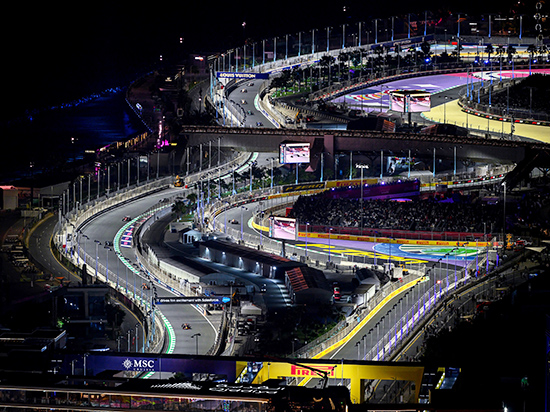
Losing the data Jeddah would have generated is, for many teams, the more significant of the two Middle Eastern cancellations. The circuit asks questions of a Formula 1 car that no other venue on the schedule quite replicates. Understanding what those questions were, and how teams are now redirecting their preparation effort, reveals the engineering precision that defines the difference between competing and winning at the front of the modern Formula 1 grid.
What Jeddah Demands from an F1 Car
The Jeddah Corniche Circuit is the fastest street circuit in Formula 1. Cars average approximately 250 km/h across the lap and regularly exceed 320 km/h on its longer sections, figures that place it in performance territory more commonly associated with low-downforce permanent circuits than a temporary street layout. Yet Jeddah is neither low-downforce nor simple.
Its 27 corners flow continuously into one another across a lap with almost no genuine breathing space, with roughly 80 per cent of the circuit spent at or near full throttle. The demands that combination places on an F1 car are unlike those of any other event.
Aerodynamically, Jeddah requires teams to solve a problem that has no clean solution. The sustained high-speed sections demand low drag to achieve competitive straight-line performance, yet the circuit's high-speed corners — many of them blind, with barriers close on both sides — require meaningful aerodynamic downforce to give the car predictable, stable handling. The trade-off between drag and downforce, always present in Formula 1, is compressed at Jeddah into unusually tight parameters. A car set up incorrectly at this circuit does not merely lose lap time. It becomes difficult to manage at speeds where the consequences of instability are severe.
The structural demands are correspondingly extreme. Where a conventional circuit produces predictable aerodynamic loading profiles that engineers can model with high confidence, Jeddah's continuous sequence of high-speed direction changes places the car's aerodynamic surfaces and suspension geometry under varied and sustained load throughout the lap.
Floor structures, front wing assemblies and rear wing configurations are all subjected to the kind of long-duration high-load cycling that accelerates fatigue in any component carrying a significant aerodynamic function. Engineers preparing for Jeddah specify with this in mind, prioritising stiffness and fatigue resistance in structural components where other circuits might allow a greater emphasis on minimising mass alone.
The night race format adds a further layer of complexity. Like Bahrain, Jeddah runs after dark, but where Sakhir's desert environment cools substantially once the sun sets, Jeddah's coastal location alongside the Red Sea produces higher residual humidity and a somewhat narrower temperature swing.
Tyre behaviour under those conditions differs from daytime running, and from the desert environment teams will have modelled for Bahrain the week before. Engineering for two consecutive night races in contrasting climatic environments requires setup work that is specific to each circuit rather than transferable between them.
What Engineers Lose Without the Data
The telemetry a Formula 1 car generates across a Jeddah race weekend is particularly valuable in the context of the 2026 technical regulations. The new rules place a substantially greater proportion of total power output through the electrical systems, and the way those systems behave under the sustained high-speed loading of a lap at Jeddah is different from any other circuit on the schedule.
At this circuit, the MGU-K's contribution across the long high-throttle sections, and its recovery behaviour at the relatively few heavy braking events, would have produced data on energy deployment and management that teams cannot generate at a circuit with a different power profile.
The handling characteristics of the 2026 cars at high-speed have also been a subject of active discussion in the paddock. Questions about aerodynamic stability and the behaviour of the active aerodynamic systems at sustained high speed were already being raised following the opening rounds in Australia, China and Japan.
Jeddah would have been the circuit where those questions were tested most rigorously, because no other venue in the early part of the calendar subjects the car to comparable sustained aerodynamic loading. That test has been deferred, and the answers will have to come from the simulator and the wind tunnel rather than from live running.
The safety car picture at Jeddah is also meaningfully different from Bahrain, and its absence from the calendar alters the data set teams are working with. Jeddah's barrier proximity, blind corners and narrow circuit sections have historically produced safety car periods at a rate well above the calendar average.
Strategy planning for Bahrain could be approached with high confidence in clean air racing. Jeddah required teams to model a much wider range of strategic scenarios and to understand how their car's tyre behaviour under safety car conditions, and in the restart phases that follow, affected their competitive position. Engineering insight from a Jeddah race weekend feeds into strategic modelling for every other street circuit on the calendar, including Miami, which follows in the revised schedule.
How Teams Redirect the Resource
With both Middle Eastern rounds removed from the schedule, the five-week gap between Japan and Miami became a development window that no team had planned for and all are now exploiting. The factory time generated is not equivalent to the race data that has been lost — it never can be — but it is not without value, and the teams that structure it well will gain from it.
The simulator carries much of the burden. Jeddah configurations that had been built and validated ahead of the cancelled race are now being run against Miami parameters, helping engineers understand the aerodynamic crossover points between a high-speed street circuit and the Miami International Autodrome's quite different layout.
Teams that can accurately model how an aerodynamic change that improves stability at Jeddah-style sustained high speed also performs at Miami's mix of medium-speed corners and shorter straights are better positioned to bring an upgrade package to Florida that functions as intended across the full range of track conditions they will encounter.
Structural engineers have used the window to revisit components that were signed off for Jeddah's specific loading profile and assess whether any revisions are warranted for Miami's different demands. In some cases that work will confirm the original design is appropriate. In others it will identify opportunities to optimise geometry or specification for the circuits ahead.
Smiths High Performance's bespoke supply solutions and rapid response capability support exactly this kind of late-stage engineering review, ensuring that revised specifications can be fulfilled with the traceability and material quality that Formula 1's technical regulations and quality management systems require.
The Bridge to Miami
Miami International Autodrome shares the street circuit category with Jeddah but is, in engineering terms, a significantly different challenge. Average speeds are lower. The lap is shorter. The proportion of the lap spent at genuinely high-speed is reduced, and the braking zones — while numerous — are not subjected to the same sustained aerodynamic loading that Jeddah's flowing high-speed sections generate.
A car set up competitively at Jeddah is not automatically competitive at Miami, and the absence of Jeddah data means teams are arriving in Florida without one of the key reference points that would normally inform their aerodynamic direction for the season's street circuit phase.
What teams do carry forward is the simulation and design work they had completed for the cancelled events. Aerodynamic models built for Jeddah's high-speed loading cases provide reference data for understanding the car's behaviour at the upper end of its operating envelope.
Structural specifications developed for sustained high-speed corner loading establish performance margins that are relevant wherever the car is operating at high aerodynamic load. Thermal analyses conducted for Jeddah's night race ambient conditions inform the engineering approach to Miami's May heat and humidity.
This transferability is central to the engineering philosophy that Smiths High Performance brings to its motorsport supply partnerships. Advanced engineering materials specified to perform under the extreme demands of the world's fastest street circuit do not cease to be relevant when that circuit is absent from the schedule. They carry their performance characteristics to whatever race comes next, and the design margins they deliver remain as relevant in Miami as they would have been on the Jeddah Corniche. The teams that work with Smiths High Performance as a Tier 1 supply chain partner bring that material performance consistency to every circuit on the calendar — and into every unexpected gap between them.
Smiths High Performance is a leading international stockholder and supplier of advanced engineering materials to Formula 1 and the wider motorsport sector. To discuss your material requirements, visit smithshp.com or contact the technical team directly.