
Estrella Galicia Grand Prix of Spain: Circuito De Jerez-Àngel Neito
The engineering challenges behind the Andalusian heat. There is something about Jerez that separates it from almost every other circuit on the MotoGP calendar. Not just the passion of the Spanish crowd, which fills over 250,000 grandstand seats and makes the Circuito de Jerez-Àngel Nieto feel like the epicentre of global motorcycle racing.
Not even the drama of its final corner — the Jorge Lorenzo hairpin — which has delivered some of the most extraordinary conclusions in Grand Prix history. What truly distinguishes Jerez, from an engineering standpoint, is the sheer hostility of its operating environment.
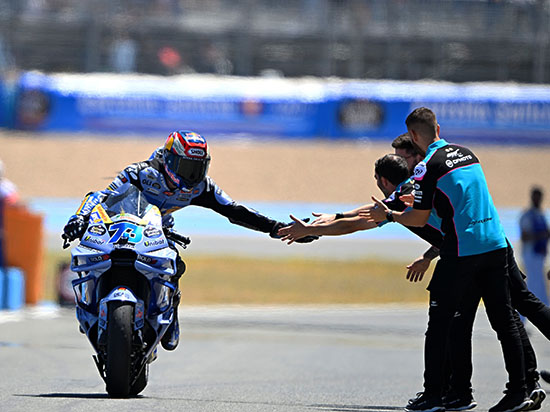
Round 4 of the 2026 MotoGP World Championship delivered exactly the kind of weekend that tests both riders and machinery to their limits: dry and blistering on Friday, wet and chaotic on Saturday, and then punishingly bright and fast on Sunday, when Alex Marquez converted his pace into a dominant victory, with Marco Bezzecchi and Fabio Di Giannantonio completing the podium. For the engineers working behind the scenes, though, that podium was the product of days of preparation, material selection and fine-tuning — and Jerez demands every bit of it.
A Circuit That Punishes Compromise
Built in 1986 and hosting its first Grand Prix one year later, the Circuito de Jerez sits in a slight valley in the south of Spain, blessed with consistently good weather and set within some of the most beautiful scenery on the continent.
That good weather, as any MotoGP engineer will tell you, is both a gift and a problem. Track temperatures at Jerez routinely exceed 50°C during race weekends, and under exceptional conditions the asphalt surface can reach beyond 60°C in some sections. At those temperatures, tyre behaviour becomes deeply unpredictable, and the materials used throughout the bike's drivetrain, suspension and braking system are operating at or close to their design ceiling.
The circuit is 4.42km in length, with a total of 13 corners and a longest straight of just 607 metres. That relatively short straight is significant. It means riders are rarely able to coast and allow systems to cool. The circuit is almost relentlessly cornering, with MotoGP riders using their brakes 11 times per lap at Jerez — one of the highest braking frequencies on the calendar. High braking frequency combined with high ambient temperatures is exactly the scenario that separates engineering excellence from engineering compromise.
The Braking Challenge
Jerez is not the most brutal circuit in absolute terms for braking — it does not have the sustained, high-speed stops of Sepang or the sheer violence of Turn 1 at Mugello — but its relentlessness across 25 laps means cumulative heat management becomes a critical discipline.
For engineers specifying brake system components, the material choices upstream are what make this manageable. Caliper pistons, brake master cylinder internals, lever pivot components and hydraulic connection hardware all need to operate reliably as the system heats and cools cyclically, lap after lap.
The alloy grades used in these applications must combine corrosion resistance with dimensional stability, and where outright strength with minimum mass is the priority, the most highly stressed fasteners and small structural components need materials that simply will not flex under the loads generated during hard braking.
At Smiths HP, our high-performance steel and stainless steel range is held in stock specifically for these demands, and every product is fully traceable through our barcoding system — ensuring that teams and their sub-contractors can be confident in the material provenance of every component they machine.
Thermal Management and Engine Components
The heat at Jerez is not just a surface problem. The Andalusian sun heats the air, the air heats the engine, and the engine — already operating close to its thermal limits — has less margin for error.
Engine exhaust systems, valve components and thermally loaded structural parts require materials that retain their mechanical properties at elevated temperatures. As engineers adjust fuelling, engine mapping and engine braking settings to suit the circuit's corner-entry characteristics, the thermal cycling these components see across a race distance is severe.
This is precisely where the more specialised end of our alloy portfolio earns its place. High-temperature alloys that maintain structural integrity where conventional grades begin to degrade are not materials every team uses for every application — but for those chasing the final margins, they represent a genuinely differentiated solution. Smiths HP supplies exactly these grades, in stock, with the documentation and traceability that motorsport demands.
Suspension, Chassis and the Corner-Speed Equation
Jerez offers a tremendous test of machine balance and riding ability, with flowing, fast curves punctuated by a number of heavy braking zones and slow hairpins. The implication for chassis engineering is that the bike must transition rapidly between high-lean, high-speed cornering and hard, linear braking — and it must do so consistently as the tyres wear and the track surface evolves across 25 laps.
Swingarm design, linkage components and suspension rocker arms are all areas where engineers balance stiffness, compliance and mass. The alloys used in these structural applications must offer high specific strength — strength relative to weight — because in unsprung and rotating mass, every gram saved has a measurable effect on handling.
At Jerez, where lateral loading through fast corners is sustained over a long duration, fatigue performance is equally important. A component machined from substandard or incorrectly certified stock is a risk no engineering team can afford. We work regularly with teams and their component manufacturers to ensure that bar and billet supplied through Smiths HP meets the precise alloy specification and temper condition required for each application. Our in-house UKAS Accredited Testing Laboratory provides an additional layer of verification that is simply not available from a standard stockholder.
The Tyre Wear Problem
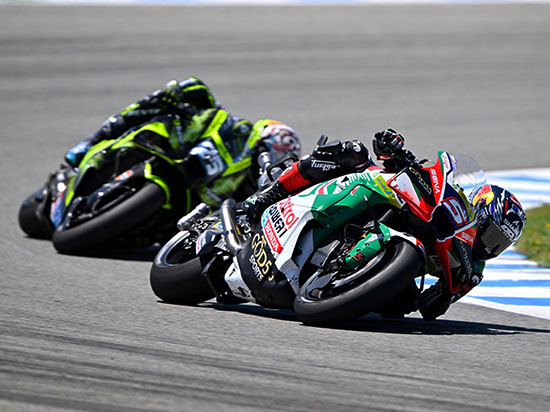
Few circuits on the calendar put tyre wear under the microscope quite like Jerez. Fast corners are a particular challenge here, especially when it comes to turning the bike naturally, and improving in this area is directly linked to better tyre wear management over race distance. This was a dominant theme in the post-race test that followed Sunday's grand prix, with multiple manufacturers running specifically targeted programmes to understand and reduce degradation.
Tyre wear is not directly a materials supply issue, but the knock-on effects very much are. When engineers are forced to manage tyre wear through chassis geometry changes, swingarm stiffness alterations or suspension linkage modifications, the components required are often needed on tight lead times under significant pressure.
The ability to receive correctly certified, pre-cut billet or bar within 24 to 48 hours of a design decision is not a marginal supply chain benefit — at a circuit like Jerez, where the post-race test immediately follows the Grand Prix and teams are developing solutions in real time, it can be the difference between testing a fix on Monday or waiting until Le Mans.
The Aerodynamic Dimension
The 2026 Jerez weekend also underlined how far aerodynamics has moved up the priority list for MotoGP engineers. At the post-race test, Aprilia were running sensors to measure turbulence and air pressure in the bike's wake, KTM brought a new fairing that their riders described as significantly positive for turning, and Ducati focused on improvements in braking and corner entry partly through aerodynamic changes.
Aerodynamic bodywork on a MotoGP bike is predominantly carbon fibre, but the substrate structures, attachment brackets and internal stiffening elements are typically machined from high-strength lightweight alloys. Where weight reduction is the overriding driver, engineers reach for the most aggressive strength-to-weight options available — and Smiths HP stocks the grades that make those solutions possible.
A Weekend That Rewarded Preparation
Sunday's race at Jerez was, in the end, a demonstration of what happens when everything aligns. Alex Marquez was consistent, measured and fast across the full race distance, managing his tyres better than anyone in the field and exploiting the chaos created by his brother Marc's early crash to establish an unassailable lead. Bezzecchi extended his championship advantage with a composed runner-up finish, while Di Giannantonio delivered the kind of race that confirms his status as a genuine front-runner.
Behind those results, though, were thousands of engineering decisions — material selections, machining tolerances, surface treatments, heat treatment specifications — that determined whether each component would survive the weekend's thermal and mechanical demands without issue. That is the unglamorous, unbroadcast side of MotoGP engineering, and it is the side that Smiths HP exists to support.
Whether it is providing high-temperature alloy bar for exhaust components on a tight pre-race deadline, supplying fully certified lightweight billet for a revised linkage tested overnight at Jerez, or helping an engineer select between competing alloy families for a new aerodynamic bracket, our role is to ensure that the right material is available when it is needed, in the right form, with the right documentation. In a sport where the margin between first and fifth can be measured in fractions of a second over 110km of racing in the Andalusian heat, that supply chain reliability is not a background function. It is part of the competitive infrastructure.
The championship moves on to Le Mans next, where the challenges will be different — cooler temperatures, a longer straight, and different demands on braking and traction. But the fundamental requirement remains constant: materials that perform, verified by people who understand why it matters.
Smiths HP is a Tier 1 supply chain partner to the global motorsport industry, supplying high-performance alloys and engineering plastics to Formula 1, MotoGP, WEC, NASCAR and WRC. Contact us at info@smithshp.com or call +44 (0)1767 604 708.