
Miami 2026: Engineering a Car for a Circuit That Fights Back
Kimi Antonelli took his third consecutive victory of the 2026 season at the Miami Grand Prix, but the result obscured how technically demanding the weekend had been. A circuit that alternates between flat-out straights and punishingly tight corners, in subtropical heat, on a surface that changes behaviour throughout the weekend — Miami asked hard questions of every engineering and design decision made back at the factory.
Heat That Engineers Cannot Ignore
Florida in May is not a forgiving environment for a Formula 1 car. Ambient temperatures, high humidity, and a dark asphalt surface that absorbs and radiates heat aggressively combine to push the thermal operating conditions of every component on the car beyond what teams encounter at most European rounds. Track surface temperatures can swing substantially across a single day as the sun moves and cloud cover changes — and this year, with the race moved forward three hours to avoid forecast thunderstorms, the cars ran under conditions that had not been part of the original preparation models.
For engineers and designers, heat is the problem that never stays still. A component designed to operate within acceptable temperature bounds at Suzuka — where Antonelli had won the previous round — faces different conditions entirely at Miami. The power unit is running at or near maximum output for long periods on the straights, generating sustained thermal load on exhaust systems, turbo housing, and the structures immediately surrounding the engine. At the same time, the brakes are absorbing enormous energy at the end of those same straights, generating their own intense localised heat load in the suspension corner. Managing where that heat goes — and ensuring that the materials carrying structural loads do not reach temperatures at which their mechanical properties begin to degrade — is one of the core engineering tasks at Miami.
Nickel superalloys such as Inconel are the standard solution in the hottest parts of the power unit, precisely because they retain their strength and resist oxidation at temperatures that would compromise aluminium or steel components. But the challenge is not just peak temperature tolerance; it is the repeated thermal cycling that Miami's layout imposes. A car covering 57 race laps at Miami transitions between maximum thermal load on the straights and the different — but still high — thermal demands of heavy braking and high-traction cornering, dozens of times. Components that can survive peak temperature in isolation may accumulate fatigue through those cycles that a single-temperature endurance test would never reveal.
The Conflicting Demands of Speed: Stiff or Compliant?
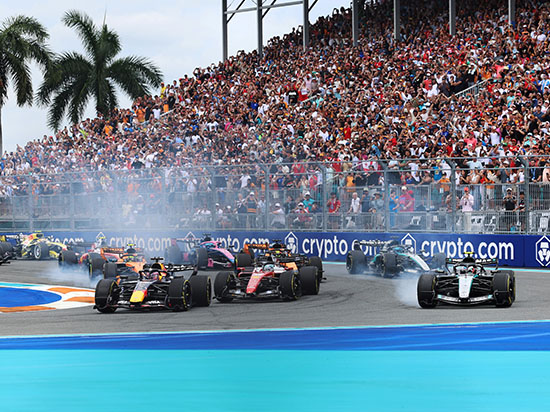
The fundamental engineering tension at Miami is one of opposites. The long straights demand a car set up to minimise aerodynamic drag and maximise top speed — which pushes towards a stiffer, lower ride-height configuration that maintains consistent aerodynamic load. The tight, slow stadium section and the heavy braking zones demand mechanical grip, suspension compliance, and the ability to rotate the car through corners where aerodynamic downforce contributes relatively little.
These two requirements pull in opposite directions, and the structural materials throughout the car have to accommodate both. Suspension components are a clear example. At high speed, lateral stiffness is critical: any flex in a wishbone or upright under aerodynamic load introduces unintended changes to the car's geometry and therefore its aerodynamic behaviour. On entry to a slow corner after heavy braking, those same components must handle large, rapidly changing load vectors as the car decelerates, turns, and transfers weight.
High-strength aluminium alloys — grades selected for their combination of stiffness, fatigue resistance, and low mass — are the material solution to that dual demand. The design challenge is ensuring that the geometry is optimised for both regimes without the component becoming so heavy that it defeats the purpose of using advanced alloys in the first place. The gearbox casing and its associated structural elements face a related problem, as the gearbox is both a load-bearing structural member — carrying rear suspension loads — and a thermally stressed component sitting close to the power unit. Aluminium alloy casings must maintain dimensional accuracy under thermal load; any distortion changes the geometry of the drivetrain and the suspension mounting points it carries.
Engineers designing for Miami have to account for the temperature differential between the gearbox at the start of a lap — still hot from the previous sequence of corners — and the additional thermal input it receives from a kilometre of flat-out running.
Carbon Fibre: Precision That Cannot Drift
The aerodynamic surfaces of a Formula 1 car are predominantly carbon fibre composite, and at Miami the demands on those surfaces are exacting. The floor, the diffuser, and the bodywork are designed to generate downforce within very precise tolerances — tolerances that are validated in the wind tunnel and the simulator, and must then be reproduced accurately on a circuit where conditions are anything but controlled.
Carbon fibre's vulnerability in this context is thermal distortion. In Miami's heat, with track temperatures that can shift substantially across a race weekend as the dark asphalt absorbs and releases stored energy, carbon fibre components can expand and distort in ways that alter their aerodynamic profile. A floor that is perfectly optimised at the start of the race may behave differently once the car and the track have reached full operating temperature. Designers account for this through the specification of the carbon lay-up — the orientation and weave of the fibre within the resin matrix — to control thermal expansion characteristics, balancing stiffness against the need to accommodate heat without dimensional drift.
Miami's smooth surface also means the floor is working in a particularly unforgiving environment. The lack of track roughness that a more abrasive circuit would provide removes one mechanism by which small aerodynamic imperfections are naturally damped; every detail of the floor's behaviour is exposed. The section between Turns 13 and 16, where the circuit passes over ramps beneath the Florida Turnpike and introduces gradient changes and surface irregularities, adds further demands on the floor's structural integrity and the composite's ability to handle localised impact loads without delamination.
The Additional Complication: A Surface That Evolves
A temporary circuit like Miami starts each race weekend with minimal rubber laid down — the asphalt has been a car park since the previous year's race, and the first cars on it in Free Practice are working with grip levels that will be significantly lower than those available to qualifying runners on Saturday. That evolution has direct consequences for material behaviour, because it changes the loads the car experiences across the course of the weekend.
Components sized and specified based on simulator data and load predictions from previous years have to perform across that grip range. Higher grip means higher cornering forces, which means higher loads through suspension, uprights, and chassis attachment points. As the track rubbers in and grip increases through the weekend, the stress environment for structural components shifts.
A design that is comfortably within its load envelope on Friday morning is working harder by Saturday qualifying — and engineers must ensure that the safety margins in the materials they have specified are adequate for the peak conditions at the end of the weekend, not just the average across it.
The Factory Advantage of Five Weeks
The cancellation of the Bahrain and Saudi Arabian Grands Prix — both removed from the 2026 calendar following the outbreak of conflict in the Middle East — gave teams an unplanned five-week interval before Miami. For the engineers and designers working on these material-level challenges, that time had real value. The first three rounds in Australia, China, and Japan had generated real-world load data, thermal measurements, and component behaviour information that pre-season simulations could not fully anticipate — particularly under the 2026 regulations, which introduced a substantially revised power unit architecture.
Five additional weeks meant more time to process that data, refine finite element models, and make informed decisions about material specifications and component designs ahead of Miami. Where a component had shown unexpected behaviour in the first three rounds — a thermal issue, a fatigue concern, an aerodynamic surface that had not performed as modelled — there was time to address it properly rather than patch it between race weekends.
That said, the benefit was not equal across the grid. The cancellation of Bahrain was a particular loss for teams that had planned to introduce upgrade packages there, using the pre-existing baseline data from pre-season testing at the same circuit to evaluate new parts. That clean comparative environment — rare in Formula 1 — was not available at Miami, where the evolving track surface and variable conditions make it harder to isolate the effect of a new component from everything else that is changing around it. Teams that had banked on Bahrain for upgrade validation arrived in Miami with more uncertainty in their development picture than they had planned for.
Engineering in the Unknown
What Miami crystallises, more than most rounds on the calendar, is that Formula 1 engineering at the material level is not about finding an answer and executing it. It is about managing competing constraints — heat and structural load, stiffness and compliance, aerodynamic precision and thermal expansion — across a circuit that imposes those constraints simultaneously and at pace. The materials inside the car are the mechanism through which engineers resolve those tensions, and the quality and consistency of those materials is what determines whether the resolution holds for 57 laps in the Florida heat.
Antonelli's victory this year was testimony to a car that held together under those demands. The engineering work that made that possible started long before the race weekend — and will continue into Montreal and beyond.
Smiths High Performance supplies advanced engineering materials to Formula 1 teams and motorsport supply chain partners worldwide. From high-performance aluminium and titanium alloys to nickel superalloys and carbon fibre, our materials are specified for the most demanding operating conditions in motorsport. Explore our materials range or contact our technical team to discuss your requirements.