
Michelin Grand Prix of France - Circuit Bugatti, Le Mans: The Stop-and-Go Challenge and the Materials That Meet It
If Jerez is the circuit that punishes machines with heat, Le Mans is the one that punishes them with violence. Round 5 of the 2026 MotoGP World Championship delivered a weekend of extraordinary drama at the Bugatti Circuit — a Sprint race in which Jorge Martin launched from eighth to the lead in the space of two corners, and a Grand Prix that began as a Bezzecchi masterclass before Martin dismantled it in the final three laps to cross the line first, take an all-Aprilia podium with Bezzecchi and debutant podium finisher Ai Ogura, and close the championship lead to a single point.
Ducati Lenovo, meanwhile, suffered another painful Sunday as Pecco Bagnaia crashed from second with ten laps remaining. For the engineers in the garages, the result was the culmination of a weekend that demanded something quite different from what Jerez had asked just a fortnight earlier.
The challenges at Le Mans are not those of sustained heat or relentless high-speed cornering. They are the challenges of repetitive mechanical shock, unpredictable weather, and a circuit layout that asks more of a motorcycle's drivetrain and braking architecture than almost any other venue on the calendar.
A Circuit Built Around Punishment
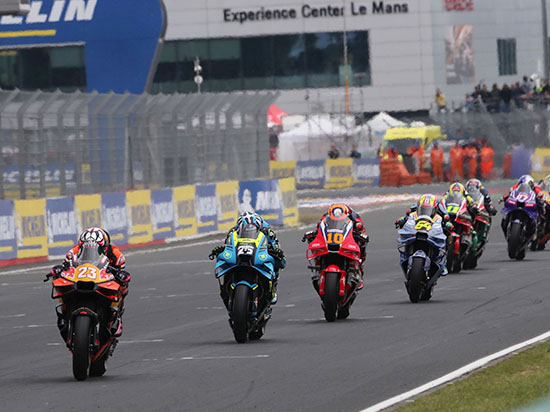
Le Mans is a tight track dominated by first-gear corners that place the emphasis on late braking and hard acceleration, whilst rear-end traction is also a key area. That description, while concise, understates the engineering implications considerably. The circuit is 4.19km in length, with a longest straight of just 674 metres and nine right-hand corners to five left. The consequence of that geometry is a layout that never allows the bike to settle into a rhythm. It is stop, accelerate, stop, accelerate — repeatedly, for 27 laps and 113km of racing.
The circuit alternates between heavy braking zones, peaking at 1.5g according to Brembo data, and short-gear acceleration bursts, with the main straight limiting top speeds to around 327km/h, well below current MotoGP records.
What that means in practice is that the mechanical loads cycling through every component on the bike are not sustained in any one direction. They are reversed constantly. Braking hardware goes from cold to hot in an instant. Drivetrain components shift between compressive and tensile loading with every throttle input. The chassis and swingarm absorb impact and flex in sequences that are shorter and more abrupt than at flowing, high-speed circuits. It is a fundamentally different test of material endurance from Jerez — and one that has a very different set of engineering solutions.
The Cold Weather Problem
Le Mans in May typically presents cool, variable and frequently wet conditions. The circuit is susceptible to unstable weather, and the generally cool temperatures force engineers to prioritise thermal management — not to dissipate heat, as at Jerez, but to generate and retain it. This reversal of the thermal challenge is one of the most instructive things about Le Mans as an engineering exercise.
One of the principal challenges at the French Grand Prix is keeping brakes and tyres up to working temperature. In cool and wet conditions, teams must actively work to prevent heat loss from the braking system, because sufficient brake temperature is essential not only for stopping performance but also for maintaining the heat that helps the tyre do its job.
The methods teams use range from disc covers and ventilation management through to careful selection of compound grades and brake pad specifications — but they all ultimately depend on the underlying material properties of the components involved. An alloy that dissipates heat efficiently is a liability in Normandy. The same property that makes it ideal for Jerez makes it a problem at Le Mans, which is why the engineers who know their materials portfolio deeply are better placed than those who do not.
At Smiths HP, supporting customers across the full calendar means understanding that the same engineering team can be looking for very different performance characteristics in successive rounds. Our role is to know the stock — and know which options are relevant for which environment.
The Braking Intensity at Le Mans
Despite the cooler temperatures moderating thermal stress on braking components, Le Mans is still deeply demanding on the braking system — and in a different way from most circuits. Turn 1 demands braking from over 250km/h into the famous chicane complex, while the double right-hander features the circuit's hardest braking zone, shedding 180km/h in just 200 metres. The Musée chicane forces riders to scrub 200km/h in 4.5 seconds — a severe test for carbon brakes.
The critical word there is severe. The deceleration events at Le Mans are not the sustained, temperature-accumulating affairs of Sepang, but they are sharp and violent, and they come with little recovery time in between. The mechanical loads on brake caliper hardware, master cylinder internals, and the structural components that hold the braking system in precise alignment are therefore significant — not from fatigue over a long thermal cycle, but from repeated peak loading in short succession. The alloys used in these components need to perform consistently under those conditions without dimensional change that would compromise pedal feel or braking balance as the race progresses.
This is also why supply chain reliability around the French Grand Prix matters. Teams frequently make component-level changes between Jerez and Le Mans to account for the different operating conditions, and the ability to receive correctly certified bar or billet at short notice is, at this point in the season, simply a competitive requirement.
Traction: The Defining Engineering Problem
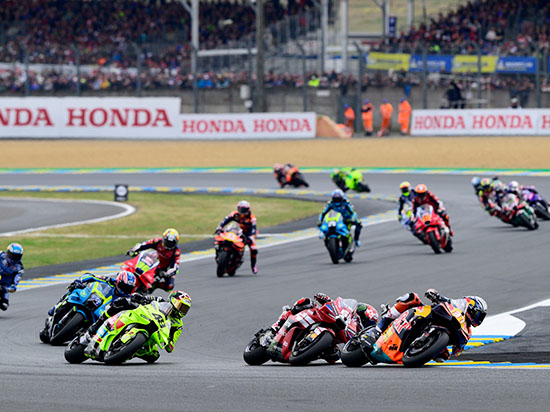
If braking is the headline challenge at Le Mans, traction is the defining one. The relatively slow corner speeds at Le Mans place more emphasis on acceleration and braking rather than outright corner speed, and the stop-and-go layout creates a large number of acceleration zones where rear traction is critical.
In cool conditions, generating heat in the rear tyre quickly is essential — and the engineering decisions that affect how a bike transmits power to the rear wheel are numerous and interconnected.
Swingarm stiffness, linkage geometry, and suspension component tuning all influence how the rear tyre loads up under acceleration and how consistently it can put power down without spinning. The alloy grades used in these components determine how much flex is in the system and where it occurs — and small differences in material specification can have measurable effects on bike behaviour at circuit like Le Mans, where the bike is on full throttle or hard on the brakes for almost the entire lap.
Jorge Martin's ability to work progressively through the field on Sunday without destroying his rear tyre in the process was a demonstration of how well-resolved Aprilia's overall package was at this round. Behind that resolution are engineering decisions made weeks and months before the race, at least some of which come down to the materials used in key drivetrain and chassis components.
Weather Variability and the Engineering Response
The 2026 Le Mans weekend, like many before it, illustrated the other great engineering challenge that this circuit presents: weather that can change the nature of the race entirely between sessions. While Friday and Saturday's Sprint were largely dry, the broader weekend saw variable conditions that required engineers to think across multiple scenarios simultaneously. Building a bike that is competitive in both dry and wet conditions — while maintaining the specific low-temperature operating performance that Le Mans demands — requires component choices that do not sacrifice performance at the margins in either direction.
For materials suppliers, weather variability at Le Mans underlines the importance of stocking a complete range rather than a narrow selection. Teams do not always know until Friday morning which set of engineering solutions they are optimising for, and the ability to supply the right material quickly — when that decision has been made — is what distinguishes a genuine supply partner from a catalogue operation.
Smiths HP holds stock specifically to serve these rapid-response scenarios, and our UKAS Accredited Testing Laboratory means that material supplied under time pressure comes with the same verification as material ordered weeks in advance.
An Aprilia Moment — and What It Means
Sunday's podium at Le Mans was historic. An all-Aprilia top three — Martin, Bezzecchi and Ogura — marked the first MotoGP podium lockout for the Noale manufacturer, the product of a development trajectory that has accelerated sharply over the past eighteen months. Martin's victory was his first Grand Prix win with Aprilia and his first Sunday victory since Indonesia in 2024, completing a Sprint and Grand Prix double that made him the first rider to achieve that feat with two different manufacturers.
For the engineers and supply chain partners who have supported that development, the Le Mans podium is not just a race result — it is the visible outcome of years of material iteration, component development and performance testing. Smiths HP has been part of the MotoGP supply ecosystem throughout that period, working with teams and sub-contractors across the paddock to ensure that the raw materials required for cutting-edge component manufacture are available when needed, in the grades required and with the documentation to match.
Heading to Barcelona
The championship now travels to the Circuit de Barcelona-Catalunya for Round 6, with Bezzecchi leading Martin by a single point in what is becoming one of the more compelling title battles of recent seasons. Barcelona presents yet another distinct engineering environment — a circuit that combines high-speed sections and extended cornering with an abrasive surface that places its own particular demands on tyres, suspension and chassis components.
The pattern of the season so far — different circuits, different operating conditions, different engineering priorities at each round — is a reminder that there is no single material solution that works everywhere in MotoGP. The teams that win championships are those whose engineering decisions hold up across all 22 rounds, in conditions ranging from the Andalusian heat of Jerez to the cool, grey unpredictability of Le Mans. Smiths HP exists to support those decisions with the right materials, the right verification and the right supply chain infrastructure to make them stick.
Smiths HP is a Tier 1 supply chain partner to the global motorsport industry, supplying high-performance alloys and engineering plastics to Formula 1, MotoGP, WEC, NASCAR and WRC. Contact us at info@smithshp.com or call +44 (0)1767 604 708.