
The Circuit That Tests Everything: What the MotoGP US Grand Prix at COTA Demands of Engineers, Materials and Machines
Marco Bezzecchi crossed the finish line at the Circuit of the Americas on Sunday to claim his fifth consecutive MotoGP victory, extending what is now a record-breaking run of consecutive laps led in the premier class. His Aprilia RS-GP26 took the flag two seconds ahead of team-mate Jorge Martin, with KTM's Pedro Acosta completing the podium. It was, on the face of it, a dominant result. But the story behind that result, and the broader engineering narrative that played out across the entire COTA weekend, tells you far more about the state of MotoGP in 2026 than any finishing order alone can.
For engineers, materials scientists, and performance partners working with these teams week in and week out, Austin is not simply another race venue. It is one of the most technically demanding environments in world motorsport, and the challenges it presents reach into every part of how a MotoGP machine is conceived, built, and developed.
A Track Built on Shifting Ground
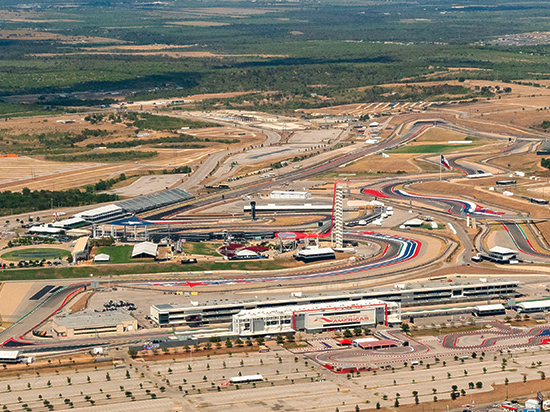
The Circuit of the Americas was purpose-built in 2012, designed by German circuit architect Hermann Tilke, and immediately earned a reputation as one of the most varied and technically demanding layouts on the MotoGP calendar. Its 5.513-kilometre lap features 20 corners, 11 left-handers and 9 right-handers, a main straight where bikes routinely exceed 350km/h, and a dramatic 40-metre elevation change at Turn 1 that creates one of the most spectacular braking zones in the sport.
But COTA has a problem that no amount of design brilliance can entirely engineer away: the ground beneath it moves. The circuit is built on expansive clay sub-soil, a geological characteristic of the Austin area, which shifts seasonally as it absorbs and releases moisture. That movement works its way upward through the asphalt layer, creating bumps and surface variations that have been a defining feature of racing at COTA since the venue first hosted MotoGP in 2013.
The issue is structural rather than superficial. Partial resurfacing, which COTA has carried out on multiple occasions over the years, addresses the visible symptom without treating the underlying cause. Different patched sections of asphalt cure and flex at different rates, creating abrupt transitions between grip levels mid-corner that MotoGP riders and engineers must account for in their setup strategy. The circuit currently combines multiple types of asphalt surface, some of which have also been treated with micro-grooves etched artificially into the track to improve grip, a measure that boosts mechanical traction at the cost of dramatically accelerating tyre wear. Add Texas heat, track temperatures routinely reaching 50°C during the race window, and you have a surface environment that places thermal and mechanical demands on tyres, suspension, and chassis components that most circuits on the calendar simply cannot replicate.
Marc Marquez, the seven-time COTA winner, provided an unintentional demonstration of exactly how unforgiving the revised surface can be when he crashed at 190km/h at Turn 10 during Friday's opening practice session. He later attributed the fall explicitly to attacking the track without adjusting for the change in surface conditions from the previous year. Marquez walked away with bruising. The bike, and its carbon fibre bodywork, titanium exhaust, and composite structural components, were less fortunate.
The Tyre Equation: Asymmetric Loads and an Unusual Circuit Direction
COTA's counter-clockwise layout is rare on the world stage and creates loading conditions that feel instinctively wrong to engineers and riders accustomed to predominantly clockwise circuits. The majority of corners at COTA are left-handers, which loads the left shoulder of the rear tyre more consistently over a lap. But the critical stress generator is a rapid sequence of right-hand turns, corners 16, 17, and 18, which subject the right shoulder of the rear tyre to concentrated, repeated high loads that are disproportionate to the overall circuit layout.
The consequence is an asymmetric rear tyre requirement, confirmed by Michelin's track racing manager Piero Taramasso ahead of this weekend. The right side of the rear tyre needs a reinforced construction to survive that triple right-hander sequence, whilst the left side must remain compliant enough to provide the edge grip the long left-handers demand. Finding a compound that satisfies both requirements simultaneously, across 20 laps at 50°C track temperatures on a surface that is abrasive at some points and slippery at others, is one of the most complex single-tyre engineering challenges in the championship calendar.
This weekend, every rider in the MotoGP class converged on medium rubber front and rear for the grand prix, a unanimous choice that itself tells a story. The medium's thermal properties provided more consistent performance across the full race window than the soft would have managed on a track surface this abrasive. Martin's medium rear gamble in the Sprint had already proven the concept the previous day; for the grand prix, it was simply the only rational engineering choice. The Sprint had also demonstrated its opposite lesson: Francesco Bagnaia's soft rear tyre faded badly in the closing laps, costing him the Sprint victory and informing every team's grand prix strategy. Bagnaia's race-day fade to tenth is a direct consequence of the same issue recurring over a longer distance.
Aprilia's Aerodynamic Masterstroke
The RS-GP26 that Bezzecchi rode to victory is, from an engineering standpoint, one of the most technically audacious machines in MotoGP's current grid. Aprilia's technical team, led by Fabiano Sterlacchini and Marco De Luca at its Noale headquarters, entered the 2026 season with a ducted aerodynamic system that drew immediate comparisons to the infamously clever McLaren F-Duct that briefly revolutionised Formula 1 in 2010.
The system works through two intake ducts positioned at the nose of the fairing, channelling air to outlets on the trailing edge of the front bodywork, directly in front of the rider's knees. Behind those outlets sit a pair of aggressive vertical winglets that, crucially, can only generate cornering downforce when the rider hangs off the inside of the bike in a corner, opening the duct exit with the natural positioning of their knee. On the straight, the rider's leg blocks the duct, reducing drag without any additional conscious action. In braking zones, where riders extend their inside leg, the duct opens again to feed horizontal wing surfaces connecting the vertical winglets to the tail unit, increasing front-end stability at precisely the moment a rider needs it most.
The elegance of the solution is that it requires no active hydraulic or electronic actuation. The rider's own body position is the switch. At COTA, with its long main straight, its severe Turn 1 braking zone, and its rapid-fire corner sequences, that combination of drag reduction on the straight and enhanced braking stability is a performance advantage that is immediately quantifiable in lap time. The fact that Bezzecchi could sustain competitive lap times in the closing stages of the race, with rear aero damage sustained from contact with Acosta on lap one, speaks to the aerodynamic package's robustness as much as its outright performance advantage.
Under the bodywork, the RS-GP26's 90-degree V4 engine produces in excess of 280bhp whilst screaming past 17,500rpm, figures that place extraordinary demand on every component in the drivetrain and chassis. The engineering challenge is not simply generating that power; it is transmitting it reliably to a 60mm-wide rear tyre contact patch through surface transitions that can change grip levels within a single corner.
What COTA's Bumps Mean for Materials and Components
For the engineers and materials suppliers working at the boundary between the race team and the physical limits of these machines, COTA's unique surface character translates directly into specific component demands that must be anticipated well before the transporters arrive in Texas.
The sustained vibration loading from riding over a bumpy circuit at race speed is categorically different from the smooth-surface loads a chassis and suspension system experience at, say, Jerez or Silverstone. At COTA, the chassis must absorb high-frequency impact loads across the full race distance, 20 laps covering 110km, without fatiguing in ways that alter handling characteristics or, in extreme cases, compromise structural integrity. The flex characteristics of a carbon fibre or aluminium chassis affect tyre contact patch behaviour, particularly under the combined loading of a bump mid-corner, and any deviation from the design intent becomes immediately apparent in rider feedback and lap time.
Suspension components are exposed to impact forces at COTA that can be significantly higher than the same components experience elsewhere on the calendar. Fork internals, swingarm pivots, and linkage components must manage peak loads that dwarf the steady-state cornering and braking forces that most design targets centre around. The material choices for these components, titanium alloys, high-performance aluminium grades, specialised steels, must accommodate both the sustained fatigue cycling of a full season's racing and the peak impact events that COTA specifically generates. When Acosta crashed in the warm-up session at Turn 2 on Sunday morning, it was a reminder of how quickly a single high-speed impact event can destroy components that have been engineered to micron tolerances over months of design and manufacture.
The thermal environment adds a further layer of complexity. At 50°C track temperature, with the engine producing upwards of 280bhp and the brakes working their hardest through the Turn 1 complex, the temperature gradients across components in and around the braking and drivetrain systems are extreme. Materials must retain their mechanical properties across this temperature range without dimensional creep or property degradation that would alter the calibrated behaviour of the system they form part of.
The Human Factor: Rider Physics and Material Consequence
MotoGP sits in a different engineering space from Formula 1 in one fundamental respect: the rider is not isolated from the machine. The physical loads a MotoGP rider experiences at COTA, documented in harrowing detail by riders over the years, cascade directly into engineering requirements.
Francesco Bagnaia famously described COTA as having left him with his body "fully destroyed" after a single day of practice in a previous year, citing back and wrist loads from the bumps as genuinely injurious. A plate surgically implanted in Maverick Viñales' arm after a previous injury had a screw work itself loose over the COTA weekend, he faces an operation in the coming days to correct it. The same impact forces that compromise a titanium bone plate at speed are working on the metallic and composite components of the bike itself.
This physical reality means that the materials used in a MotoGP machine's contact points and interfaces, handlebar grips, foot peg mounts, fairing stay structures, seat unit composites, are not merely structural components. They are, in a meaningful sense, rider protection elements.
Their stiffness, damping characteristics, and failure modes directly affect the forces transmitted to the rider's body. Engineering them to manage COTA's impact environment without adding mass that compromises the bike's dynamic performance is a precision balance that plays out in materials selection as directly as it does in chassis design.
Smiths High Performance: Engineering Partnership Across the Full Season
For Smiths High Performance, supplying advanced engineering materials to MotoGP teams from its UK facility in Biggleswade and its Italian base in Maranello, the Austin weekend generated the kind of data that feeds directly back into the ongoing engineering conversation with each team's technical staff.
A weekend like COTA is instructive precisely because its demands are so specific and so different from the rounds that immediately flank it on the calendar. The data from a fatigued suspension component at Austin looks different from the same component's data at the previous round in Brazil. The thermal cycling a braking component experienced in Texas's afternoon heat tells engineers something useful about the margins available in the material's operating envelope that a European round in cooler conditions cannot replicate. That knowledge is not filed away for next year's COTA preparation, it feeds into the assessment of components being prepared for Jerez in April, and informs whether material specifications for upcoming parts need adjustment.
This is what continuous engineering partnership in MotoGP actually means in practice.
The traditional distinction between "build season" and "race season" has largely dissolved at the top level of the sport. Teams are developing, revising, and replacing components throughout the calendar. When Aprilia arrives in Jerez having demonstrated at three consecutive rounds that the RS-GP26 is the dominant machine on the grid, every rival team is working in the weeks between races to understand which aspects of their own package need to be addressed, and many of those answers involve materials decisions. A revised swingarm specification, a new chassis option to test during practice, an updated brake caliper mounting bracket: each of these starts as an engineering question and arrives at Smiths as a materials requirement, often with a very short lead time.
Smiths HP's dual presence in Biggleswade and Maranello is not coincidental geography. Biggleswade places the company at the centre of European motorsport's engineering corridor, within practical reach of teams and their subcontract manufacturing partners. Maranello positions Smiths within the Italian racing engineering ecosystem, relevant not just to the teams based in northern Italy, but to the broader supply network that supports MotoGP across its European operations. When a team needs a material specification confirmed, a non-standard alloy sourced, or an urgent quantity of a specific grade delivered to a manufacturer on a tight production schedule, that proximity matters.
In a season where Aprilia has made clear that it intends to be the dominant technical force in the final year before MotoGP's major 2027 regulation reset, and where KTM and Ducati are working urgently to close the gap, the engineering conversation across the paddock is running at full intensity. The gap between Austin and Jerez will be used by every team's technical group to review, revise, and, where necessary rebuild. Smiths High Performance will be part of that conversation, as it is throughout the season: not as a passive supplier waiting to fill orders, but as an active engineering partner to the teams that are pushing the boundaries of what two wheels and a rider can achieve.
Smiths High Performance supplies advanced engineering materials to MotoGP teams across the full grid, from its facilities in Biggleswade, UK and Maranello, Italy. To discuss your engineering materials requirements, contact the team at www.smithshp.com or call +44 (0)1767 604708.