
Steel, Aluminium and Alabama: What the IndyCar Race at Barber Reveals About the Engineering Art of Going Racing
Alex Palou does not lose at Barber Motorsports Park. The four-time and reigning IndyCar champion extended that particular truth on Sunday, winning the Children's of Alabama Indy Grand Prix from pole position, leading 79 of 90 laps and crossing the line 13.3 seconds ahead of Arrow McLaren's Christian Lundgaard.
Graham Rahal completed the podium for Rahal Letterman Lanigan Racing, ending a personal drought stretching back to August 2023. Every one of the 25 starters reached the chequered flag. Not a single safety car disrupted 90 laps of racing around one of North American motorsport's most visually stunning and technically demanding circuits.
It was, in other words, a day that looked simple from the outside. From the inside, where engineers, materials scientists, and performance partners live, it was anything but.
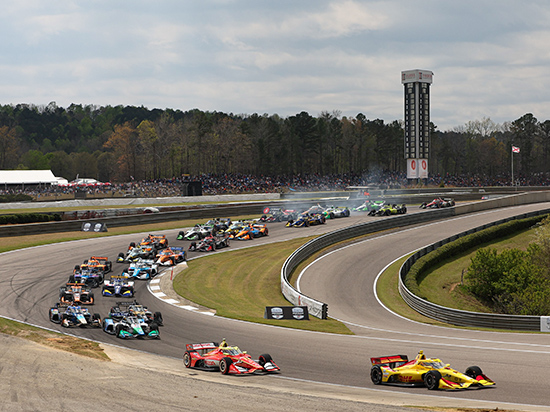
The Rollercoaster: What Barber Demands of a Race Car
Barber Motorsports Park sits on 880 acres of rolling Alabama countryside outside Birmingham, and the circuit earns its affectionate nickname, the rollercoaster, through 80 feet of dramatic elevation change distributed across 17 flowing corners on a 2.3-mile lap. Unlike many permanent road courses designed with safety run-off as the primary constraint, Barber's layout follows the natural contours of the land beneath it. The result is a circuit that places unusual and variable loading demands on every dynamic system of a racing car.
The elevation changes are not merely aesthetic. Cresting a rise mid-corner alters the vertical load on the tyre contact patch in a fraction of a second, shifting the car's grip balance in ways that are extraordinarily difficult to predict precisely in simulation. Running into a compression at the bottom of a hill reverses the effect, loading the tyres suddenly and generating peak forces through the suspension that are significantly higher than the same corner would produce on a flat circuit. Engineers at every team must calibrate their suspension geometry, spring rates, and damper settings to manage these load transitions without either bottoming the car on the compression or losing grip at the crest. At Barber, getting this wrong does not simply mean losing a tenth of a second per lap, it means the car becomes unpredictable for the driver at precisely the moments when circuit geometry already demands maximum commitment.
Josef Newgarden's troubled afternoon illustrates the stakes. The three-time Barber winner reported a vibration from early in the race, a handling issue that persisted through all three tyre stints and ultimately cost Team Penske's No. 2 Chevrolet the front-running position it had qualified into. The vibration cascaded into wider handling problems as the race progressed, suggesting an interaction between the mechanical imbalance and the variable load inputs the circuit was generating. Penske's strategy team made the decision to bring Newgarden in earlier than planned on his first stop to investigate, a mid-race reactive engineering call that disrupted his tyre stint lengths and cost him the lap time he would have needed to challenge for the podium. Scott McLaughlin's race told an equally instructive technical story: debris gradually blocked the brake ducts on his Odyssey Battery Chevrolet during the second half of the race, causing progressive brake overheating that in turn pushed rear tyre temperatures beyond their operating window. The handling degradation accelerated as each lap passed, dropping McLaughlin from a potential top-ten to a 16th-place finish.
Barber does not forgive margin violations. That is, ultimately, what makes it such a revealing circuit.
The IndyCar: A Different Philosophy, A Different Set of Material Demands
Understanding what Smiths High Performance brings to IndyCar teams requires first understanding what an IndyCar actually is, and how profoundly different the engineering philosophy underpinning it is from Formula 1.
The current generation IndyCar is built around the Dallara DW12 chassis with the IR-18 universal aero kit, a specification that, in its base monocoque form, has been in continuous use since the 2012 season. The safety cell is constructed from carbon fibre and aluminium, with a steel roll hoop bolted to the tub behind the driver's head. The engine, a 2.2-litre twin-turbocharged V6 supplied by either Honda or Chevrolet, acts as a structural stressed member, with the gearbox, rear suspension, and rear crash structure bolting directly to it. The whole package weighs approximately 770 kilograms on a road course, runs on E85 ethanol fuel, and produces north of 700 horsepower from the internal combustion engine alone, supplemented, since the hybrid system's race debut in 2024, by an energy recovery unit that adds a further 80-100 horsepower in short deployment bursts.
The deliberate specification philosophy, a single chassis supplier, a common aero kit, two engine manufacturers, one tyre supplier, is the defining characteristic that separates IndyCar from Formula 1 at the most fundamental engineering level. In F1, the competitive battleground is the car itself: every team designs and builds their own chassis, their own aerodynamic surfaces, their own cooling architecture, optimising relentlessly within the regulatory envelope. At IndyCar, the chassis is essentially equalised. The competitive battleground shifts to setup, strategy, driver talent, and the marginal gains that teams can extract through the components, materials, and sub-assemblies they source from their tier-one supplier network.
This distinction matters enormously for understanding where advanced engineering materials fit into the IndyCar ecosystem. In F1, a superior aluminium alloy choice in a suspension component might represent one strand of a competitive advantage assembled from hundreds of design decisions across an entirely bespoke car. In IndyCar, that same alloy choice, applied to a gearbox casing, a brake caliper bracket, a suspension upright, or any of the other non-spec components teams are permitted to develop, carries proportionally greater weight, because the car around it is standardised. The material choice is not one variable among many; it can be the variable.
The Hybrid System: IndyCar's New Engineering Frontier
The arrival of IndyCar's hybrid energy recovery system in 2024, and its full integration into the 2026 specification, has added a new dimension to the materials and engineering challenge facing every team and their supply chain.
The system is architecturally elegant in its simplicity relative to F1's approach. At its core is a 48-volt Motor Generator Unit paired with a 320 kilojoule supercapacitor Energy Storage System, both of which are packaged within the bellhousing between the internal combustion engine and the gearbox, a space already under significant structural and thermal stress. The entire Energy Recovery System weighs 42.5 kilograms and must survive the same shock, vibration, and thermal loads as the components surrounding it, in a package that was designed around a purely mechanical drivetrain. The supercapacitors store harvested energy and deploy it on driver demand, providing an additional power boost through what IndyCar terms the Push-to-Pass system; with hybrid deployment active, total system output exceeds 800 horsepower in short bursts.
Packaging 42.5 kilograms of hybrid hardware into an existing powertrain architecture is not an abstract engineering exercise. Every bracket, every mounting point, every heat shield, and every structural interface between the hybrid unit and the surrounding components must be designed and manufactured to tolerances that maintain the geometry of the drivetrain under the dynamic loads of racing.
The materials used in those interfaces must manage the thermal gradient between the ICE, which generates significant heat in normal operation, and the supercapacitor stack, which requires its own temperature management to maintain performance and longevity. This is precisely the kind of multi-physics engineering problem, mechanical load, thermal management, weight constraint, and packaging geometry operating simultaneously, where advanced alloy selection and material specification translate directly into a working system rather than a compromised one.
The strategic dimension of the hybrid system was on full display at Barber. Palou's post-race comments acknowledged openly that his team "suffered a little" on the used primary (hard) tyre set they were forced to use for their second and third stints as a consequence of their strategy. Lundgaard, running the quicker but less durable alternate compound, was eating into Palou's lead at roughly half a second per lap before Palou's final pit stop reset the gap. The engineers who could extract the most consistent energy recovery, maximising the supercapacitor's deployment bandwidth without degrading its output over 90 laps, were able to partially compensate for the tyre strategy compromise. The material integrity of the supercapacitor packaging and the thermal management of the ERS housing are not separate conversations from the lap time the driver produces: they are, in a very direct sense, the same conversation.
Where IndyCar and F1 Converge — and Where They Part Ways
The comparison between IndyCar and Formula 1 is frequently framed as a competition: which is faster, which is more technically advanced, which produces better racing? That framing misses the more interesting engineering story, which is one of deliberate philosophical divergence in service of different goals, and the surprising degree of technical convergence at the component and materials level beneath those different philosophies.
Both series run carbon fibre monocoques as their structural core, both use aluminium extensively in suspension and drivetrain components, both have adopted hybrid energy recovery systems, both run on bio-based or partially renewable fuel blends, and both subject their vehicles to the kind of thermal and mechanical cycling that makes material selection a precision discipline rather than a specification exercise. The specific alloy grades used in an IndyCar upright and an F1 upright will differ in their exact composition and heat treatment, but both are products of the same engineering decision tree: the highest strength-to-weight ratio available at the operating temperature, with fatigue properties that survive the load cycle count the racing season imposes, manufactured to tolerances that maintain calibrated geometric relationships through the life of the component.
Where the philosophies genuinely diverge is in the engineering freedom available above the chassis specification. F1 teams operate with an enormous design freedom that demands a correspondingly enormous engineering infrastructure, hundreds of designers, analysts, and manufacturing specialists working continuously on the car's aerodynamic and structural development. IndyCar's specification architecture compresses the competitive engineering challenge into a narrower but no less demanding space: setup optimisation within a fixed chassis envelope, powertrain tuning within a two-manufacturer framework, and component development in the permitted non-spec areas. The result is a series where team engineering quality, including the quality of the materials decisions made by tier-one suppliers and their partners, has a direct and legible influence on race results in a way that is sometimes harder to isolate in F1's more complex competitive environment.
There is also a mechanical durability dimension that differs sharply between the two series. A Formula 1 power unit is designed around a performance life measured in hundreds of kilometres, with strict allocation limits enforcing a reliability discipline that teams would not otherwise choose. An IndyCar engine is designed to last approximately 2,500 miles, roughly five to six race distances, before a rebuild. The engineering philosophy that produces a 700-horsepower unit capable of that durability, running on E85 ethanol fuel and surviving the thermal cycling of ovals, road courses, and street circuits in the same season, demands material choices oriented as much toward sustained mechanical integrity as peak performance. The aluminium alloys in an IndyCar engine and drivetrain are not simply performing to a specification on the test bench; they are performing to that specification for race after race, in varying climates, with varying fuel loads and turbo boost settings, at a per-unit cost that imposes its own engineering discipline.
The Spec Car's Hidden Complexity: Where Tier-One Suppliers Earn Their Place
There is a misconception, persistent among casual observers of IndyCar, that the specification nature of the series reduces the role of advanced engineering suppliers. In fact, the opposite is closer to the truth.
Precisely because the chassis is standardised, the non-spec components that teams develop, suspension elements, uprights, brake system componentry, gearbox casings and internal components, cooling system architecture, hybrid system packaging and structural interfaces , carry maximum competitive significance. A team that sources superior materials for its permitted development components, or that works with a materials supplier capable of delivering non-standard alloy grades or tighter-tolerance stock, is extracting advantage from a competitive space that every other team can also access in principle. The difference is in the quality of the engineering relationships and the depth of the technical materials support.
For Smiths High Performance, operating from Biggleswade in the UK and Maranello in Italy, the IndyCar paddock represents exactly the kind of environment where its supply model delivers most clearly. Teams competing at Barber this weekend are not waiting for the off-season to address the material specifications of components that were stressed in ways they had not anticipated. The Penske engineers reviewing Newgarden's vibration issue will trace the chain of mechanical events back through the suspension and drivetrain components that were exposed to it, looking for evidence of fatigue or deformation that informs how the affected parts are built or specified going forward. McLaughlin's brake duct debris problem will prompt a review of the duct aperture and internal ducting material's resistance to progressive blockage, a specific mechanical behaviour that depends as much on material surface characteristics as on the geometry of the duct design.
These reviews do not wait for Long Beach or Indianapolis. They happen in the days after Barber, feeding directly into component orders and material specifications that must be delivered in time for the next round. Lundgaard's runner-up finish, compromised at the decisive moment by a rear-right wheel not being properly fastened during his pit stop, extending his service from the seven-second target window to over thirteen seconds, is a reminder that the competitive margins in IndyCar are often decided by execution at the boundary between engineering and human performance. The materials and components that the engineering chain produces must be dimensionally consistent enough that fitting them under race conditions, in a seven-second window, is a repeatable and reliable act.
Engineering Support Without Borders: The Smiths High Performance Model
The IndyCar season is a genuinely global engineering challenge compressed into a North American racing calendar. Teams based in Indianapolis, Speedway, Zionsville, and Brownsburg, the tight cluster of Indiana facilities that forms IndyCar's equivalent of the Silverstone corridor, are drawing on a global supply network for the advanced materials and engineering inputs that their cars require. European materials suppliers, including those with direct connections to the Formula 1 and MotoGP supply chain, are an established part of that network.
Smiths position, with a UK base that serves the densely concentrated European motorsport engineering community, and an Italian facility at Maranello that places the company within the Emilia-Romagna engineering ecosystem from which Dallara itself operates, means that the IndyCar supply relationship is not a remote transatlantic transaction. It is a live engineering conversation, informed by what teams in Formula 1 are discovering about the same alloy families and material grades under F1's own extreme conditions. When a nickel superalloy behaves in a specific way under sustained thermal cycling in an F1 turbocharger application, that data is relevant to how the same alloy family will perform in an IndyCar turbo system running at comparable temperatures. When aluminium-lithium grades are validated for specific structural applications in F1 chassis components, the engineering rationale for those choices is directly transferable to IndyCar permitted development components where weight reduction is equally valued.
This cross-series knowledge flow is one of the less visible but genuinely significant advantages of working with a materials supplier that operates across multiple top-tier racing categories simultaneously.
Palou's Chip Ganassi Racing Honda was not, on Sunday, the product of a single engineering discipline or a single national supply chain. It was the assembled result of an international engineering ecosystem, and the materials decisions that supported it were made, in part, by conversations that reached from Indiana to Biggleswade and back again
The next round at Long Beach in April will ask different questions of these cars and their engineering teams. A street circuit imposes its own specific material challenges: kerb strikes, concrete barriers, the absence of the natural run-off that makes Barber a circuit where mistakes are punished but recoverable. The material specifications selected for Alabama will be reviewed against what Long Beach demands. Some will be carried over. Others will be refined. The engineering conversation, as it always is in top-level motorsport, continues without pause.
Smiths High Performance supplies advanced engineering materials to racing teams across Formula 1, MotoGP, IndyCar, and allied motorsport categories, from its facilities in Biggleswade, UK and Maranello, Italy. To discuss your engineering materials requirements, contact the team at www.smithshp.com or call +44 (0)1767 604708.