
Lessons from the Paddock: What the Japanese Grand Prix Revealed About F1's Most Demanding Engineering Era
Three rounds into the 2026 Formula 1 season, and one thing is already abundantly clear: this is the most technically unforgiving regulatory era the sport has ever produced.
The Japanese Grand Prix at Suzuka delivered a race of genuine drama and unpredictability, but also a stark reminder that raw engineering competence is separating the field in ways not seen since the turbulent early hybrid years of 2014. For the engineers, material suppliers, and performance partners working behind the scenes, every race weekend is generating data that will shape the rest of the season and beyond.
China's Reckoning: When the Grid Fell Apart
Before Suzuka could tell its story, the engineering community needed to absorb the lessons of Shanghai. The Chinese Grand Prix was, by any measure, a reliability catastrophe for several of F1's most prominent teams, and the technical postmortem made uncomfortable reading.
McLaren's double DNS was perhaps the most startling result. Both Oscar Piastri and Lando Norris failed to take the grid, the result of two separate electrical faults on the power unit side, remarkable given that McLaren uses the Mercedes power unit, widely regarded as the benchmark of the 2026 generation. The failures underlined a fundamental challenge with the new regulations: the electrical architecture of these cars is exponentially more complex than anything that came before, and even marginal integration failures carry race-ending consequences.
Max Verstappen's retirement told a similarly instructive story. Red Bull confirmed his RB22 suffered an ERS coolant failure, the team choosing to retire the car to protect the hardware rather than risk destroying a power unit component that carries strict allocation limits across the season. Red Bull team principal Laurent Mekies was candid in his assessment, acknowledging "significant shortcomings" in the car's overall package, not just the reliability failure, but the fundamental performance deficit that had Verstappen qualifying eighth and describing the RB22 as "incredibly tough to drive" and "a fight every lap."
Aston Martin's double DNF in China compounded a miserable start to their 2026 campaign. Running Honda power for the first time, the Silverstone-based team acknowledged that reliability had improved compared to Melbourne, but "this isn't yet enough to complete the full race distance." The team's own statement was notably candid: "The 2026 regulations are far from simple, as shown by the number of DNFs and DNSs today."
Seven retirements or non-starts across a single grand prix. In an era of meticulous pre-race preparation and near-clinical reliability, that number speaks volumes about the scale of the engineering challenge teams are navigating with these regulations.
What Makes the 2026 Power Unit So Demanding
To understand why China produced such carnage, you need to understand what the 2026 power unit actually asks of its engineering systems.
For the first time in F1 history, the power split between the internal combustion engine and the electrical system is roughly 50/50. The MGU-K, the motor-generator unit on the crankshaft, has been uprated from 120kW to 350kW, a near-tripling of electrical output. The MGU-H, which recovered energy from the turbocharger and acted as a buffer between the thermal and electrical systems, has been removed entirely. That removal was deliberate, it dramatically reduced the cost of entry for new manufacturers, but it also eliminated a component that had, over a decade of development, become extraordinarily effective at managing energy flow and thermal stability.
The result is a system that is both more powerful and significantly more thermally stressed. The ERS must recover up to 9MJ of energy per lap, managing enormous electrical currents through components that must survive an entire race distance at temperatures and vibration levels that would destroy conventional electronics. Cooling circuits for the ERS are under constant pressure, which is precisely what caused Verstappen's retirement in China, a coolant failure in the energy recovery system. McLaren's separate electrical faults pointed to integration and software challenges at the boundary between the power unit and the chassis electrical architecture.
For a company like Smiths High Performance, supplying advanced engineering materials to teams across the entire grid from its bases in Biggleswade and Maranello, China reinforced lessons that Smiths and their team partners had already been working through since pre-season: the thermal and mechanical demands on components in and around the 2026 power unit are categorically different from anything the previous generation required.
Suzuka: A Circuit That Exposes Every Weakness
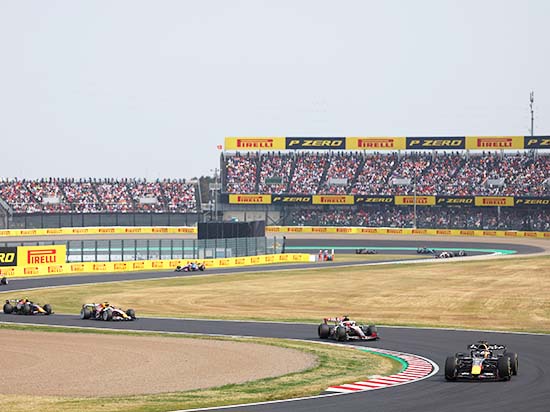
Suzuka has always been a brutal examiner of engineering integrity. Its 5.8-kilometre layout is unique in demanding genuinely high-speed cornering commitment sustained over extended sectors. The sweeping S-Curves in the opening section, the double apex Degner corners, and particularly the flat-out 130R left-hander place sustained lateral loads on tyres, suspension components, and aerodynamic surfaces that most circuits simply do not replicate. Teams cannot hide setup compromises at Suzuka the way they occasionally can at a street circuit or on a more forgiving permanent venue.
For the 2026 cars, Suzuka introduced an additional layer of engineering jeopardy: the interaction between the active aerodynamic system and the circuit's energy recovery zones. Under the new regulations, cars switch automatically between high-downforce Corner Mode and low-drag Straight Mode as they transit between track sectors. Suzuka's layout, with its very high cornering loads followed by relatively short straights, creates demanding transition demands on the active aero system, with wing angles changing rapidly and repeatedly in ways that place significant cycling stress on the actuation mechanisms.
The circuit also stretches the ERS recovery cycle in ways that more straightforward tracks do not. With relatively few long conventional braking zones, the system must harvest energy more aggressively under partial throttle and through aero drag recovery, placing higher average thermal loads on the battery and cooling architecture over the full 53-lap race distance. Teams that had reliability concerns coming into Suzuka, most obviously Aston Martin, though both Ferrari and Red Bull were also managing uncertainty, needed to have resolved their thermal management strategies before the lights went out. Aston Martin's Lance Stroll retired with a suspected water pressure issue; Fernando Alonso crossed the line a lap down in 18th, the team finally completing a race distance but clearly still some distance from the performance window they need to reach.
The Bearman Incident: A Regulatory Warning Shot
The race's most alarming moment came on lap 22, when Haas driver Oliver Bearman struck the barriers at Spoon Curve at approximately 308km/h, sustaining a 50G impact. He walked away with a knee contusion. He should not have been placed in that position.
The incident exposed perhaps the most significant unresolved engineering challenge in the 2026 regulations: the dangerous speed differential created when one car is actively harvesting energy whilst another is in full electrical deployment. Bearman was running in Overtake Mode behind Alpine's Franco Colapinto, who was harvesting, decelerating significantly in the process. The closing speed between the two cars was estimated at between 35 and 50km/h, a delta with no precedent in modern F1. Telemetry suggested Bearman's approach speed was as much as 45km/h higher than on the previous lap. There were no warning lights visible on Colapinto's car at the moment of the crisis, because the Alpine was not in an active harvesting phase that triggered its warning illumination.
The FIA issued a formal statement following the race, confirming that meetings will be held during the April break, a period created by the cancellation of the Bahrain and Saudi Arabian Grands Prix, to assess whether the energy management parameters require modification before Miami. The Grand Prix Drivers' Association had already warned that these closing speed differentials would eventually produce a serious accident. Carlos Sainz noted after the race that the drivers had been raising this concern since the opening rounds and had been insufficiently heard.
For engineers working on cooling and thermal management systems, the Bearman incident carries a secondary lesson. George Russell's Mercedes also experienced a sudden dramatic speed reduction on lap 37, approaching the same corner, due to a software event causing unexpected superclipping behaviour. Two cars, two separate power unit architectures, both creating unpredictable velocity changes at a point on the circuit where drivers have no margin for sudden evasive action. The energy management software, governing how and when the ERS harvests and deploys, is now, inescapably, a safety-critical system as much as a performance tool.
A More Entertaining Race — But for the Right Reasons?
Despite these concerns, the Japanese Grand Prix delivered exactly the kind of racing that the 2026 regulations were intended to create.
Kimi Antonelli started from pole and promptly dropped to sixth after wheelspin off the line, yet went on to win. Oscar Piastri led for over a third of the race. Charles Leclerc held off George Russell for the final podium position. The mid-field order shifted significantly when a mid-sequence Safety Ca, triggered by Bearman's crash, allowed drivers yet to pit to consolidate track position.
At Suzuka historically, the winner often leads from lights to flag and the circuit's premium on aerodynamic downforce has traditionally suppressed overtaking. The 2026 regulations changed that dynamic materially. Overtake Mode, available when within one second of the car ahead and providing additional electrical energy over a lap, created genuine attacking opportunities that DRS, tied to a single straight, never could. Active aerodynamics, dropping drag simultaneously on both wings in low-drag zones, compressed lap times on the straights and made slipstreaming more accessible, particularly for the mid-field where energy management strategies diverged significantly between manufacturers.
Verstappen finished eighth, battling Gasly's Alpine for much of the second half of the race in what would have been an inconceivable midfield scrap for a Red Bull in recent seasons. This is genuinely the most open competitive landscape F1 has produced since the first year of the 2022 regulations, arguably more so, because the 2026 regulations have simultaneously reshuffled aerodynamic performance, power unit competitiveness, and software sophistication.
The Continuous Engineering Partnership: Build Season Is Never Over
For Smiths High Performance, the Suzuka weekend was another data point in what has become a year-round engineering dialogue with F1 teams. The traditional "build season" framing, the winter months when cars are designed and constructed before the campaign begins, no longer accurately describes how the sport operates. At the elite level, and particularly in a year of entirely new regulations, the engineering challenge is continuous and cumulative.
Every race produces component data that feeds directly back into the design loop. A thermal failure on lap 45 in Shanghai means that by the time the freight lands in Japan, engineers are already working on revised cooling specifications, altered material choices, and new build protocols for replacement parts. When a team brings an upgraded floor or a revised cooling exit to a race, the materials decisions supporting those changes, whether that is a lighter aluminium alloy to offset weight penalties from revised cooling architecture, a higher-temperature PEEK polymer for electrical insulation components, or a magnesium alloy for structural brackets where every gram matters, have been specified, sourced, and delivered weeks earlier in a process that is never truly paused.
Smiths HP's dual presence in Biggleswade and Maranello is not coincidental.
The Biggleswade facility serves the dense concentration of F1 teams operating along the Silverstone corridor , Mercedes, McLaren, Red Bull, Aston Martin, Williams, Racing Bulls, whilst Maranello positions Smiths at the heart of Ferrari's operational ecosystem. In a season where both Ferrari and Mercedes are front-running power unit architectures, and where component specifications are being revised and refined after every race weekend, that geographical proximity to the engineering teams translates directly into responsiveness.
In a regulation cycle as technically turbulent as 2026, that responsiveness is not a marginal advantage, it is a competitive necessity. When Red Bull are redesigning ERS cooling circuits between China and Japan, or when teams are re-evaluating the thermal properties of materials used in electrical insulation systems following the Bearman incident's focus on energy management hardware, the conversation between team engineers and material suppliers like Smiths HP is immediate, not scheduled. The April break between Suzuka and Miami will see exactly this kind of intensive engineering review taking place across the paddock, with the lessons of three races feeding into revised specifications that will begin to arrive at circuits from Miami onwards.
The 2026 season is, in every meaningful sense, an engineering season as much as a racing one. For those working at the frontier of materials science and high-performance supply, keeping every team on the grid equipped with the materials that make competitive F1 engineering possible, that is precisely the environment in which the most important work gets done.
Smiths High Performance supplies advanced engineering materials to Formula 1 teams across the full grid, from its facilities in Biggleswade, UK and Maranello, Italy. To discuss your engineering materials requirements, contact the team at www.smithshp.com or call +44 (0)1767 604708.